Energy policy of China
Videos
The People's Republic of China is both the world's largest energy consumer and the largest industrial country. China is currently the world's largest emitter of greenhouse gases, and coal in China is
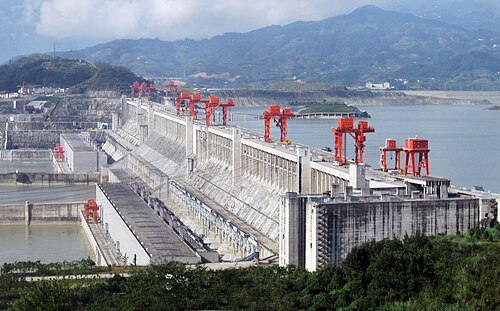
The 22,500 MW Three Gorges Dam hydroelectric power plant in China, the largest hydroelectric power station in the world.

A coal mine near Hailar, Inner Mongolia

Jinling Oil Refinery, Qixia, Nanjing

Oil well in Qaidam Basin, Qinghai
Nuclear power in China
Videos
China operates the world's second-largest fleet of nuclear power plants, behind the United States. As of August 2026, 63 nuclear reactors with net capacity 62.409 gigawatts electrical have been instal
Energy policy of China
…Renewable energy in China Wind power in China Solar power in China Nuclear power in China Economics of nuclear power plants…

Aerial view of the Haiyang Nuclear Power Plant in Haiyang, Shandong; from far to near are Reactors 1 through 4

Qinshan Nuclear Power Plant, located in Zhejiang China

Taishan Nuclear Power Plant in Taishan, Guangdong; its units 1 & 2 are two 1750 MWe class EPR reactors

Sanmen Nuclear Power Station, located in Zhejiang, China