English land law
Videos
English land law is the law of real property in England and Wales. Because of its heavy historical and social significance, land is usually seen as the most important part of English property law. Own

The area of land in England and Wales is 151,174 km2 (58,368 mi2), while the United Kingdom is 243,610 km2. By 2013, 82 per cent was formally registered at HM Land Registry. In 2010, over a third of the UK was owned by 1,200 families descended from aristocracy, and 15,354 km2 was owned by the top three land owners, the Forestry Commission, National Trust and Defence Estates. The Crown Estate held around 1,448 km2.

The Charter of the Forest 1217, a companion to Magna Carta, embodied social rights for people to use common land for hunting and farming until more and more was enclosed. Leaders of the Peasants' Revolt of 1381 preached that "matters goeth not well to pass in England, nor shall not do till everything be common, and that there be no villains nor gentlemen, but that we may be all unied [sic] together, and that the lords be no greater masters than we be".

The Court of Chancery could mitigate the injustice of strict common law rules of property, if the Lord Chancellor deemed it equitable. The court systems were merged by the Judicature Acts of 1873–1875.

After both World Wars, land management and housing increasingly came under social ownership and regulation, with new council homes, rights for tenants, and ownership interests in land recognised through contributions to family life.
Charter of the Forest
Videos
The Charter of the Forest of 1217 re-established rights of access for free men to the royal forest that had been eroded by King William the Conqueror and his heirs. Many of its provisions were in forc
English land law
…rights of representation to the barons, but contained very little for "commoners". However, a number of clauses were extracted and expanded into the Charter of the Forest 1217, which did allow people access to common land, where people could hunt and fish for food. Over the centuries, the law expanded on the extent of common…
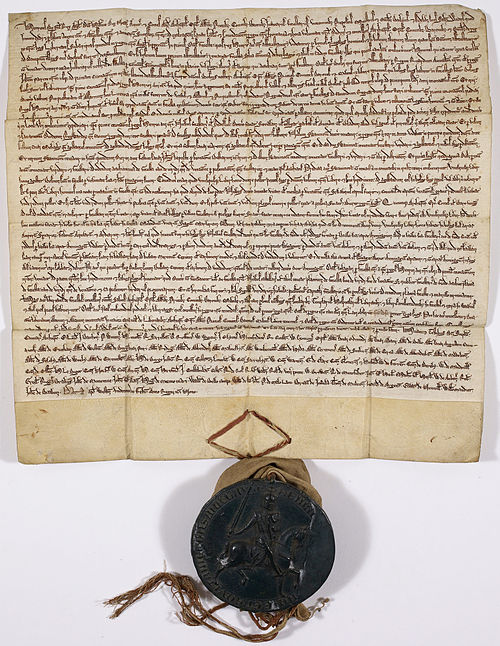
The Charter of the Forest, 1225 reissue, held by the British Library