Enigma machine
Videos
The Enigma machine is a cipher device developed and used in the early- to mid-20th century to protect commercial, diplomatic, and military communication. It was employed extensively by Nazi Germany du
Military Model Enigma I, in use from 1930


A memorial in Bydgoszcz, Poland, to Marian Rejewski, the mathematician who, in 1932, first broke Enigma and, in July 1939, helped educate the French and British about Polish methods of Enigma decryption

Enigma in use, 1943
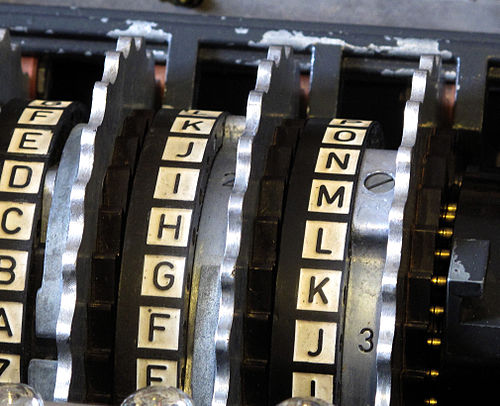
Enigma rotor assembly. In the Enigma I, three movable rotors are sandwiched between two fixed wheels: the entry wheel, on the right, and the reflector on the left.
Cryptanalysis of the Enigma
Videos
Cryptanalysis of the Enigma ciphering system enabled the western Allies in World War II to read substantial amounts of Morse-coded radio communications of the Axis powers that had been enciphered usin
Enigma machine
…major source of intelligence. Although Nazi Germany introduced a series of improvements to the Enigma over the years that hampered decryption efforts, cryptanalysis of the Enigma continued throughout the war. Many commentators say the flow of Ultra communications intelligence from the decrypting of Enigma, Lorenz, and other…

The Enigma machine was used commercially from the early 1920s and was adopted by the militaries and governments of various countries—most famously, Nazi Germany.

The plugboard (Steckerbrett) was positioned at the front of the machine, below the keys. In the above photograph, two pairs of letters have been swapped (A↔J and S↔O). During World War II, ten leads were used, leaving only six letters 'unsteckered'.

Marian Rejewski c. 1932, when he first broke Enigma

Zygalski sheet