Entebbe raid
Videos
The Entebbe raid, also known as Operation Entebbe and officially codenamed Operation Thunderbolt, was a 3 July 1976 Israeli counter-terrorist mission in Uganda. It was launched in response to the hija
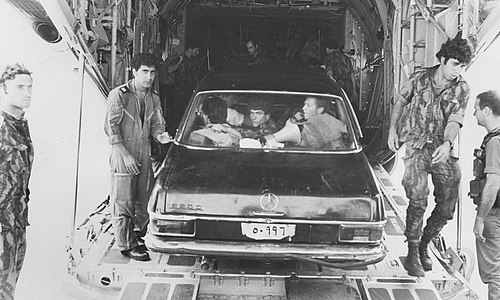
Israeli commandos with a Mercedes-Benz 600 resembling the one owned by Ugandan dictator Idi Amin, used by Sayeret Matkal to deceive Ugandan troops during the raid

F-BVGG, the Air France Airbus A300 involved, in February 1976

Aerial photo of the city of Entebbe and the Entebbe International Airport at sunset

A 1994 photograph of the old terminal with a U.S. Air Force C-130 Hercules parked in front. Bullet holes from the 1976 raid are still visible.
Idi Amin
Videos
Awon'go Idi Amin Dada Oumee was a Ugandan military officer and dictator who served as the third president of Uganda from 1971 until his overthrow in 1979. He gained power after the 1971 Ugandan coup d
Entebbe raid
…of the PFLP-EO and the German Revolutionary Cells, who diverted the aircraft to Entebbe International Airport with the backing of Ugandan dictator Idi Amin. Following the 27 June hijacking, the captors took the 248 passengers hostage with the objective of compelling the release of imprisoned Palestinian…

Amin in the UNGA, 1975

Nakasero Hill in Kampala, the district where Amin was born according to his family

Amin (centre-left) as chief of staff during a visit of Israeli Prime Minister Levi Eshkol (centre) in 1966

Many victims of Amin's regime perished in torture chambers during his reign. One such chamber is pictured.