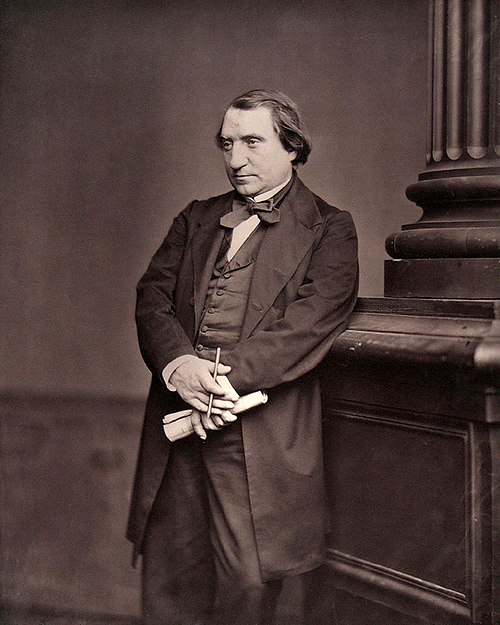
Joseph Ernest Renan was a French Orientalist and Semitic scholar, writing on Semitic languages and civilizations, historian of religion, philologist, philosopher, biblical scholar, and critic. He wrote works on the origins of early Christianity, and espoused popular political theories especially concerning nationalism, national identity, and the alleged superiority of White people over other human "races". Renan is known as being among the first scholars to advance the disputed Khazar theory, which held that Ashkenazi Jews were descendants of the Khazars, Turkic peoples who had adopted the Jewish religion and allegedly migrated to central and eastern Europe following the collapse of their khanate.
Ernest Renan circa 1870s
Ernest Renan birthplace museum in Tréguier
Portrait of Joseph Ernest Renan, by F. Mulnier
Ernest Renan in his study by Anders Zorn
Biblical criticism is the use of critical analysis to understand and explain the Bible without appealing to the supernatural. During the eighteenth century, when it began as historical-biblical criticism, it was based on two distinguishing characteristics: (1) the scientific concern to avoid dogma and bias by applying a neutral, non-sectarian, reason-based judgment to the study of the Bible, and (2) the belief that the reconstruction of the historical events behind the texts, as well as the history of how the texts themselves developed, would lead to a correct understanding of the Bible. This sets it apart from earlier, pre-critical methods; from the anti-critical methods of those who oppose criticism-based study; from the post-critical orientation of later scholarship; and from the multiple distinct schools of criticism into which it evolved in the late twentieth and early twenty-first centuries.
Title page of Richard Simon's Critical History (1685), an early work of biblical criticism
Jean Astruc, often called the "Father of Biblical criticism", at Centre hospitalier universitaire de Toulouse
Ernst Hildebrand's 1910 painting Kreuzigung Christi depicts the crucifixion of Jesus. The crucifixion is widely regarded by historians as a historical event.
The Rylands fragment P52 verso is the oldest existing fragment of New Testament papyrus. It contains phrases from the Book of John.