Ethanol fuel in Brazil
Videos
Brazil is the world's second largest producer of ethanol fuel. Brazil and the United States have led the industrial production of ethanol fuel for several years, together accounting for 85 percent of
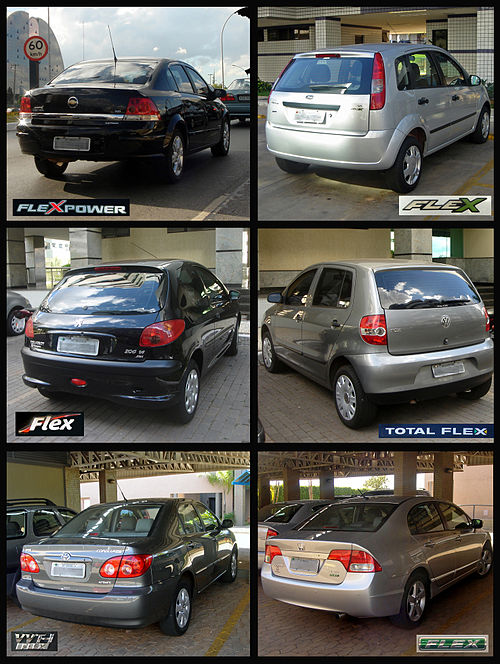
Six typical Brazilian flex-fuel models from several car makers, popularly called "flex" cars, that run on any blend of hydrous ethanol (E100) and gasoline (E20 to E25)

Brazil has ethanol fuel available throughout the country. Shown here a typical Petrobras gas station at São Paulo with dual fuel service, marked A for alcohol (ethanol) and G for gasoline.

The 1979 Brazilian Fiat 147 was the first modern automobile launched to the market capable of running only on hydrous ethanol fuel (E100).

The 2003 Brazilian VW Gol 1.6 Total Flex was the first flexible-fuel car capable of running on any blend of gasoline and ethanol.
Common ethanol fuel mixtures
Videos
Several common ethanol fuel mixtures are in use around the world. The use of pure hydrous or anhydrous ethanol in internal combustion engines is only possible if the engines are designed or modified f
Ethanol fuel in Brazil
…10% and 22%. and requiring just a minor adjustment on regular gasoline engines. In 1993 the mandatory blend was fixed by law at 22% anhydrous ethanol (E22) by volume in the entire country, but with leeway to the Executive to set different percentages of ethanol within pre-established boundaries. In 2003…

A man fueling his Pontiac GTO with gasohol in 1979

Typical warning placed in the fuel filler of U.S. vehicles regarding the capability of using up to E10 and warning against the use of blends between E20 and E85.

Typical manufacturer's statement in the car owner's manual regarding the vehicle's capability of using up to E10.

EPA's E15 label required to be displayed in all E15 fuel dispensers in the U.S.