Ethnicity
Videos
An ethnicity or ethnic group is a group of humans who identify with each other on the basis of perceived shared attributes that distinguish them from other groups. Attributes that ethnicities believe

A group of ethnic Bengalis in Dhaka, Bangladesh. The Bengalis form the third-largest ethnic group in the world, with the largest being the Han Chinese and the second largest being the Arabs.

The Javanese people of Indonesia are the largest Austronesian ethnic group.
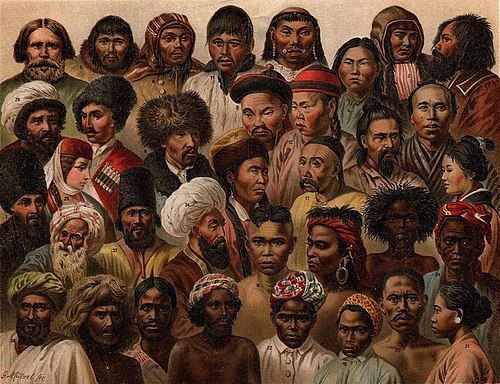
The racial diversity of Asia's ethnic groups (original caption: Asiatiska folk), Nordisk familjebok (1904)

Assyrians are one of the indigenous peoples of Northern Iraq.
Race (human categorization)
Videos
Race is a categorization of humans based on shared physical or social qualities into groups generally viewed as distinct within a given society. The term came into common usage during the 16th century
Ethnicity
…with some groups having mixed genetic ancestry. Ethnicity is sometimes used interchangeably with nation. It is also sometimes used interchangeably with race, although not all ethnicities identify as racial groups. By way of assimilation, acculturation, amalgamation, language shift, intermarriage, adoption…

The "three great races" according to Meyers Konversations-Lexikon of 1885–1890. The subtypes are: Mongoloid race, shown in yellow and orange tones Caucasoid race, in light and medium grayish spring green-cyan tones Negroid race, in brown tones Dravidians and Sinhalese, in olive green and their classification is described as uncertain The Mongoloid race sees the widest geographic distribution, including all of the Americas, North Asia, East Asia,

"Races humaines" according to Pierre Foncins La deuxième année de géographie of 1888. White race, shown in rose, Yellow (Mongoloid) race, shown in yellow, Negroid race, shown in brown, "Secondary races" (Indigenous peoples of the Americas, Australian aboriginals, Samoyedic peoples, Hungarians, Malayans and others) are shown in orange

Portrait "Redenção de Cam" (1895), showing a Brazilian family becoming "whiter" each generation