European science in the Middle Ages comprised the study of nature, mathematics and natural philosophy in medieval Europe. Following the fall of the Western Roman Empire and the decline in knowledge of
For most medieval scholars, who believed that God created the universe according to geometric and harmonic principles, science – particularly geometry and astronomy – was linked directly to the divine. To seek these principles, therefore, would be to seek God.


Ninth century diagram of the observed and computed positions of the seven planets on 18 March 816

The translation of Greek and Arabic works allowed the full development of Christian philosophy and the method of scholasticism.

Optical diagram showing light being refracted by a spherical glass container full of water (from Roger Bacon, De multiplicatione specierum)
Science in classical antiquity encompasses inquiries into the workings of the world or universe aimed at both practical goals as well as more abstract investigations belonging to natural philosophy. C

The Ptolemaic system of celestial motion as depicted in the Harmonia Macrocosmica (1661)
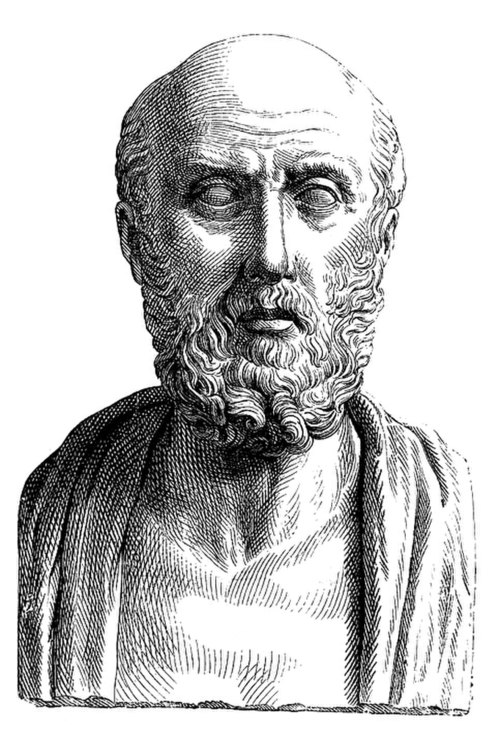
The physician Hippocrates, known as the "Father of Modern Medicine"

A mosaic depicting Plato's Academy, from the Villa of T. Siminius Stephanus in Pompeii (1st century AD)

George Trebizond's Latin translation of Ptolemy's Almagest (c. 1451)