Euston Arch
Videos
The Euston Arch, built in 1837, was the original entrance to Euston station, facing onto Drummond Street, London. The arch was demolished when the station was rebuilt in the 1960s, but much of the ori

The Euston Arch in the 1890s

Entrance Front of the London Station by C. F. Cheffins, published 3 April 1837.

Construction of the Euston Arch, London, January 1838, by John Cooke Bourne; reminiscent of David Roberts' drawings of ancient Egypt.

The breakers moved in on 6 November 1961. This photograph was taken on a wet 12 February 1962.
St Pancras railway station
Videos
St Pancras International is a major central London railway terminus on Euston Road in the London Borough of Camden. It is the terminus for Eurostar services from Belgium, France and the Netherlands to
Euston Arch
…the arch as part of the redevelopment of Euston Station could be led by Alastair Lansley, the lead architect for the reconstruction and rebuilding of St Pancras Station. On 18 February 2008 Marcus Binney reported in The Times newspaper that the arch may be rebuilt as part of the redevelopment of Euston Station from…
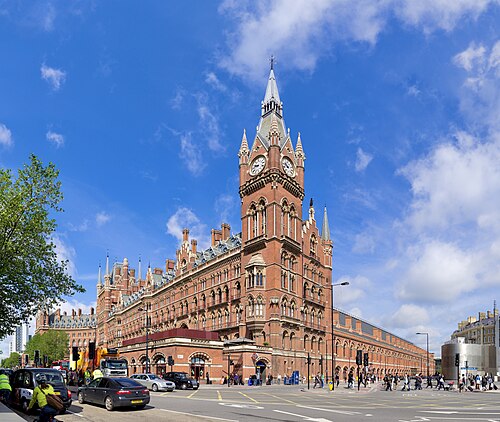
View from Euston Road

The train shed under construction in 1868

The station was damaged by a bomb in May 1941 during the Blitz.

An express to Leicester awaiting departure in 1957