Event horizon
Videos
In astrophysics, an event horizon is a boundary in spacetime beyond which no signal can ever reach a given observer. Wolfgang Rindler coined the term in the 1950s.

As the camera approaches the event horizon, the view of the outside universe appears to contract ahead while the shadow grows beneath.

Inside of the event horizon the roles of space and time switch. The singularity becomes an inevitable moment in the future and conversely the event horizon becomes a moment in the past. The black hole shadow approaches half the field of view, while simultaneously the aberration of light (due to exponentially-increasing tidal forces) concentrate the view of the outside universe into a thin band. In the final moments, all views of the outside universe eventually pinch off into total darkness.
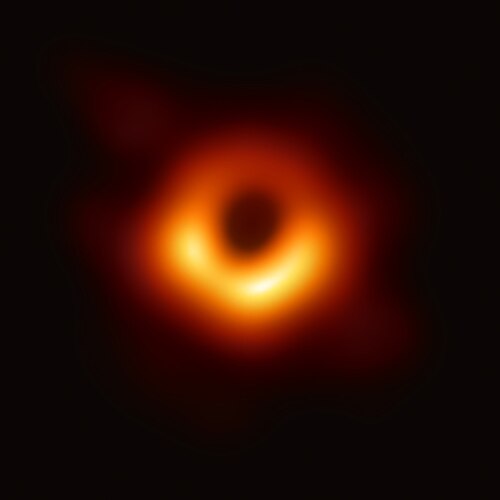
Black hole Messier 87 crop max res
Hawking radiation
Videos
Hawking radiation is radiation released outside a black hole's event horizon due to quantum effects according to a model developed by Stephen Hawking in 1974. This black-body radiation was not predict
Event horizon
…event horizons are expected to have properties that are different from those predicted using general relativity alone. At present, it is expected by the Hawking radiation mechanism that the primary impact of quantum effects is for event horizons to possess a temperature and so emit radiation. For black holes, this manifests…

Diagram by Jacob Bekenstein of the entropy on a black hole's event horizon.

Black hole evaporation takes a long time relative to the current age of the universe, for black holes larger than a proton in diameter.