Exfoliation joints or sheet joints are surface-parallel fracture systems in rock, often leading to the erosion of concentric slabs.
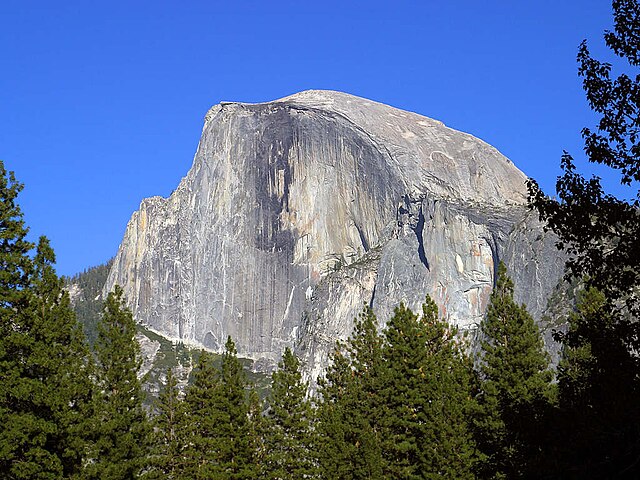
Exfoliation joints wrapping around Half Dome in Yosemite National Park, California.
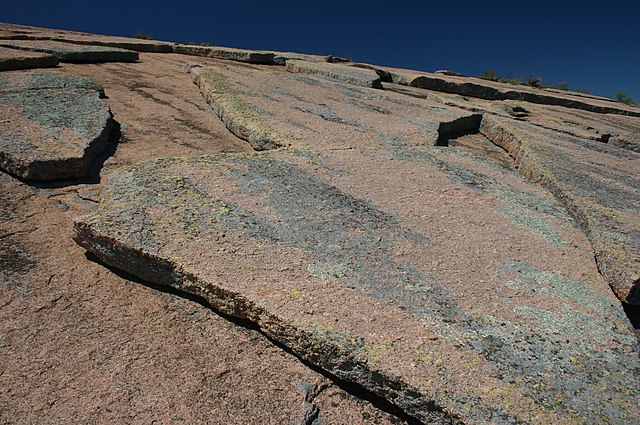
Exfoliation joints in granite at Enchanted Rock State Natural Area, Texas, US. Detached blocks have slid along the steeply-dipping joint plane.
Exfoliation joints exposed in a road cut in Yosemite National Park, California.
Exfoliation joints have modified the near-surface portions of massive granitic rocks in Yosemite National Park, helping create the many spectacular domes, including Half Dome shown here.
A joint is a break (fracture) of natural origin in a layer or body of rock that lacks visible or measurable movement parallel to the surface (plane) of the fracture. Although joints can occur singly, they most frequently appear as joint sets and systems. A joint set is a family of parallel, evenly spaced joints that can be identified through mapping and analysis of their orientations, spacing, and physical properties. A joint system consists of two or more intersecting joint sets.
Horizontal joints in the sedimentary rocks of the foreground and a more varied set of joints in the granitic rocks in the background. Image from the Kazakh Uplands in Balkhash District, Kazakhstan.
Orthogonal joint sets on a bedding plane in flagstones, Caithness, Scotland
Joints in the Almo Pluton, City of Rocks National Reserve, Idaho.
A rock in Abisko fractured along existing joints possibly by mechanical frost weathering