Extractivism
Videos
Extractivism is the removal of natural resources, particularly for export, with minimal processing. This economic model is common throughout the Global South and the Arctic region, but also occurs in

Example of extractivism: open-pit mining in Russia.

Example of European extractivism: a quarry in the Apuan Alps, Italy. No Cav is an anti-extractivism movement fighting against this activity.

Slaves clearing the Atlantic Forest in Brazil, c. 1820–1825, by Moritz Rugendas.

Example of mass extraction of trees for lumber, resulting in deforestation.
Natural resource
Videos
Natural resources are resources that are drawn from nature and used with few modifications. This includes the sources of valued characteristics such as commercial and industrial use, aesthetic value,
Extractivism
…Extractivism is the removal of natural resources, particularly for export, with minimal processing. This economic model is common throughout the Global South and the Arctic region, but also occurs in…

The rainforest in Amazon, in the Marquesas Islands, is an example of an undisturbed natural resource. The forest provides timber for humans, food, water and shelter for the flora and fauna tribes and animals. The nutrient cycle between organisms forms food chains and fosters a biodiversity of species.

The Carson Fall in Mount Kinabalu, Malaysia is an example of undisturbed natural resources. Waterfalls provide spring water for humans, animals and plants for survival and habitat for marine organisms. The water current can be used to turn turbines for hydroelectric generation.

The ocean is an example of a natural resource. Ocean waves can be used to generate wave power, a renewable energy source. Ocean water is important for salt production, desalination, and providing habitat for deep-water fishes. There is biodiversity of marine species in the sea where nutrient cycles are common.
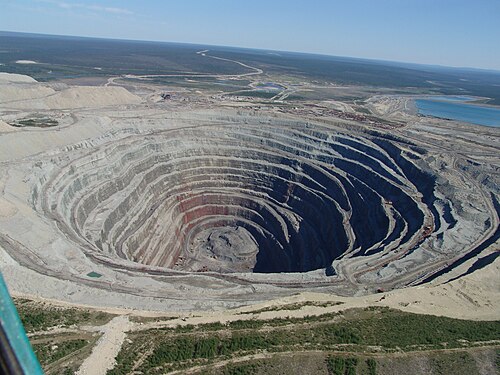
A picture of the Udachnaya pipe, an open-pit diamond mine in Siberia. An example of a non-renewable natural resource.