Extraterrestrial sky
Videos
In astronomy, an extraterrestrial sky is a view of outer space from the surface of an astronomical body other than Earth.
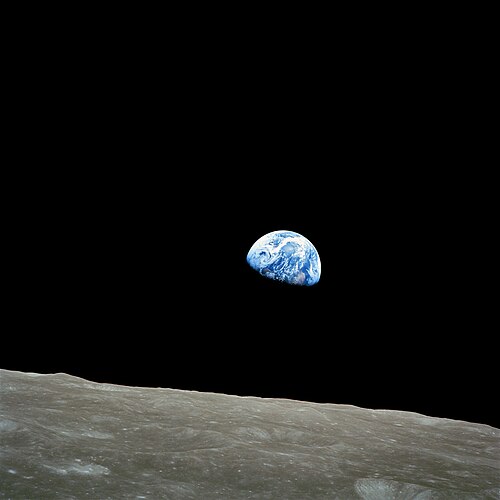
A historic extraterrestrial sky—Earthrise, the Earth viewed from the Moon. Taken by Apollo 8 astronaut William Anders while in lunar orbit, December 24, 1968.

Diagram for the formula of the angular diameter

A view of Earth with different layers of its atmosphere visible: the troposphere with its clouds casting shadows, a band of stratospheric blue sky at the horizon, and a line of green airglow of the lower thermosphere around an altitude of 100 km, at the edge of space

Night side of Earth with artificial lights and lightning in the troposphere, including at the horizon a red sprite lightning, and above the green line of airglow at the upper mesopause and border to space (the bright light above is the Moon).
Venus
Videos
Venus is the second planet from the Sun. Similar in size and mass to Earth, Venus has no liquid water, and its atmosphere is far thicker and denser than that of any other rocky body in the Solar Syste
Extraterrestrial sky
…body other than Earth. The only extraterrestrial sky that has been directly observed and photographed by astronauts is that of the Moon. The skies of Venus, Mars and Titan have been observed by space probes designed to land on the surface and transmit images back to Earth. Characteristics of extraterrestrial…

False color image of Venus as taken by Mariner 10 in 1974.

Spherical view of radar data of the surface of Venus, highlighting surface features (1989, Magellan). The colours do not represent the appearance of the surface in visible light.

Radar mosaic of two pancake domes in Venus's Eistla region—both 65 km (40 mi) wide and less than 1 km (0.62 mi) high

Impact craters on the surface of Venus (false-colour, 3D projection image reconstructed from radar data)