F-number
Videos
An f-number is a measure of the light-gathering ability of an optical system such as a camera lens. It is defined as the ratio of the system's focal length to the diameter of the entrance pupil. The f
A Canon 7 mounted with a 50 mm lens capable of f/0.95

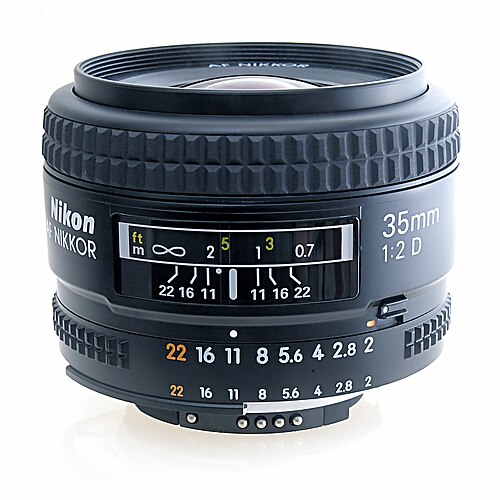
A 35 mm lens set to f/11, as indicated by the white dot above the f-stop scale on the aperture ring. This lens has an aperture range of f/2 to f/22.

Comparison of f/32 (top-left half) and f/5 (bottom-right half)

Shallow focus with a wide open lens
Depth of field
Videos
The depth of field is the distance between the nearest and the farthest objects that are in acceptably sharp focus in an image captured with a camera. See also the closely related depth of focus.
F-number
…diameter of the entrance pupil ("clear aperture"). The f-number is also known as the focal ratio, f-ratio, or f-stop, and it is key in determining the depth of field, diffraction, and exposure of a photograph. The f-number is dimensionless and is usually expressed using a lower-case hooked f with the format f/N…

A macro photograph showing the defocused effect of a shallow depth of field on a tilted page of text

This photo was taken with an aperture of f/22, creating a mostly in-focus background.

The same scene as above with an aperture of f/1.8. Notice how much blurrier the background appears in this photo.

Aperture = f/1.4. DOF = 0.8 cm