Famille d'acrobates avec singe
Videos
Photos
Famille d'acrobates avec singe is a 1905 painting by Pablo Picasso. It depicts a family of travelling circus performers during an intimate moment. The work was produced on cardboard using mixed media: gouache, watercolour, pastel and Indian ink. It is held by the Gothenburg Museum of Art in Gothenburg, Sweden. The work was painted at a key phase in Picasso's life, as he made the transition from an impoverished bohemian at the start of 1905 to a successful artist by the end of 1906.

Famille d'acrobates avec singe

Girl on a Ball or Young Acrobat on a Ball), Pushkin Museum, Moscow

Family of Saltimbanques, National Gallery of Art, Washington D.C.
Picasso's Rose Period
Videos
Photos
The Rose Period comprises the works produced by Spanish painter Pablo Picasso between 1904 and 1906. It began when Picasso settled in Montmartre at the Bateau-Lavoir among bohemian poets and writers. Following his Blue Period – which depicted themes of poverty, loneliness, and despair in somber, blue tones – Picasso's Rose Period represents more pleasant themes of clowns, harlequins and carnival performers, depicted in cheerful vivid hues of red, orange, pink and earth tones.

Pablo Picasso, 1905, Acrobate et jeune Arlequin (Acrobat and Young Harlequin), oil on canvas, 191.1 x 108.6 cm, The Barnes Foundation, Philadelphia
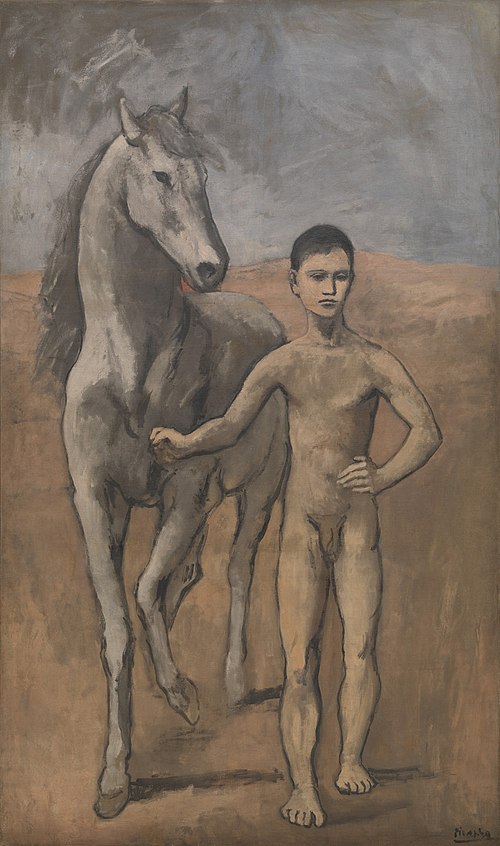
Boy Leading a Horse, 1905–06, oil on canvas, 220.6 cm × 131.2 cm (86.85 in × 51.65 in), Museum of Modern Art, New York

At the time Picasso lived at the Le Bateau-Lavoir (center) in Montmartre, Paris.

Pablo Picasso, 1904, L'acteur (The Actor), Metropolitan Museum of Art, New York