Famille jaune, noire, rose, verte are terms used in the West to classify Chinese porcelain of the Qing dynasty by the dominant colour of its enamel palette. These wares were initially grouped under the French names of famille verte, and famille rose by Albert Jacquemart in 1862. The other terms famille jaune (yellow) and famille noire (black) may have been introduced later by dealers or collectors and they are generally considered subcategories of famille verte. Famille verte porcelain was produced mainly during the Kangxi era, while famille rose porcelain was popular in the 18th and 19th century. Much of the Chinese production was Jingdezhen porcelain, and a large proportion were made for export to the West, but some of the finest were made for the Imperial court.

Moon flask (right) in famille rose, Jingdezhen porcelain, Yongzheng reign (1723–1735)

Wucai vase, Shunzhi period, circa 1650–1660

Wucai plate for exportation, Kangxi period, circa 1680

Wucai plate for exportation, Kangxi period, circa 1680
Overglaze decoration
Videos
Overglaze decoration, overglaze enamelling, or on-glaze decoration, is a method of decorating pottery, most often porcelain, where the coloured decoration is applied on top of the already fired and glazed surface, and then fixed in a second firing at a relatively low temperature, often in a muffle kiln. It is often described as producing "enamelled" decoration. The colours fuse on to the glaze, so the decoration becomes durable. This decorative firing is usually done at a lower temperature which allows for a more varied and vivid palette of colours, using pigments which will not colour correctly at the high temperature necessary to fire the porcelain body. Historically, a relatively narrow range of colours could be achieved with underglaze decoration, where the coloured pattern is applied before glazing, notably the cobalt blue of blue and white porcelain.


Nabeshima ware plate with floral design, Arita, Japan, late 17th century, Edo period.
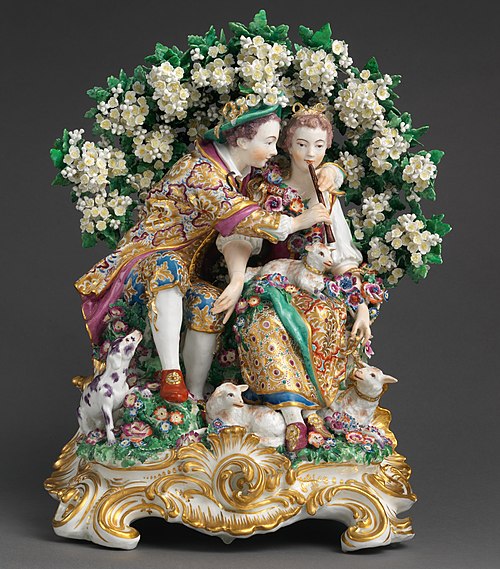
Chelsea porcelain factory, The Music Lesson, gold anchor, c. 1765, with bocage background. 15 3/8 × 12 1/4 × 8 3/4 inches, 22 lb. (39.1 × 31.1 × 22.2 cm, 10 kg). different version, different angle.