Famine
Videos
A famine is a widespread scarcity of food caused by several possible factors, including, but not limited to: war, natural disasters, crop failure, widespread poverty, an economic catastrophe or govern
Two men and a child, all dead from starvation during the Russian famine of 1921–1922


Skibbereen, Ireland during the Great Famine, 1847 illustration by James Mahony for the Illustrated London News

People waiting for famine relief in Bangalore, India (from the Illustrated London News, 1877)
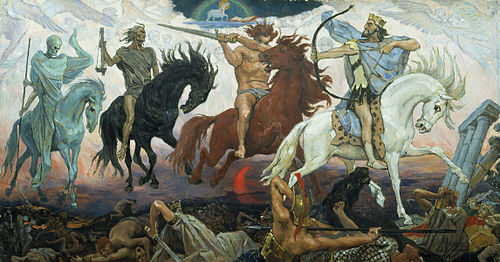
Four Horsemen of the Apocalypse, an 1887 painting by Russian artist Viktor Vasnetsov. Depicted from left to right are Death, Famine, War, and Conquest.
Holodomor
Videos
The Holodomor, also known as the Ukrainian famine, was a massive man-made famine in Soviet Ukraine from 1932 to 1933 that killed millions of Ukrainians. The Holodomor was part of the wider Soviet fami
Famine
…the famine of 1891–1892. The Russian famine of 1921–22 killed an estimated 5 million. Famines continued in the Soviet era, the most notorious being the Holodomor in various parts of the country, especially the Volga, and the Ukrainian and northern Kazakh SSR's during the winter of 1932–1933. The Soviet famine…

Starved peasants on a street in Kharkiv, 1933, Ukraine's capital at the time

Postcard commemorating the 15th anniversary of the Holodomor, which shows Stalin looking at his kolkhoz built on a pile of starved Ukrainians. Published in 1948 by the Ukrainian Youth Association.

A "Red Train" of carts from the "Wave of Proletarian Revolution" collective farm in the village of Oleksiyivka, Kharkiv oblast in 1932. "Red Trains" took the first harvest of the season's crop to the government depots. During the Holodomor, these brigades were part of the Soviet Government's policy of taking away food from the peasants.

A print from a postcard designed by Zofia Nalepińska-Bojczuk, referring to the Holodomor, 1935