The fangxiangshi was a Chinese ritual exorcist, the meaning of whose name is obscure but has been translated as "one who sees in all (four) directions", "he who scrutinizes for evil in many directions", and "one who orients unwanted spirits in the direction to which they belong". Ancient Chinese texts record that he wore a bearskin with four golden eyes, and carried a lance and shield to expel malevolent spirits. His primary duties were orchestrating the seasonal Nuo ritual to chase out disease-causing demons from houses and buildings, and leading a funeral procession to exorcize corpse-eating wangliang spirits away from a burial chamber. From the Han dynasty through the Tang dynasty, fangxiangshi were official wu-shaman specialists in the imperially sanctioned Chinese state religion; after the Tang, they were adapted into popular folk religion and symbolized by wearing a four-eyed mask.
Chinese Eastern Han dynasty (25-220 CE) tomb guardian figure identified as a Fangxiangshi
Japanese Hōsōshi 方相氏 exorcist illustration from the (c. 1781) Konjaku Hyakki Shūi
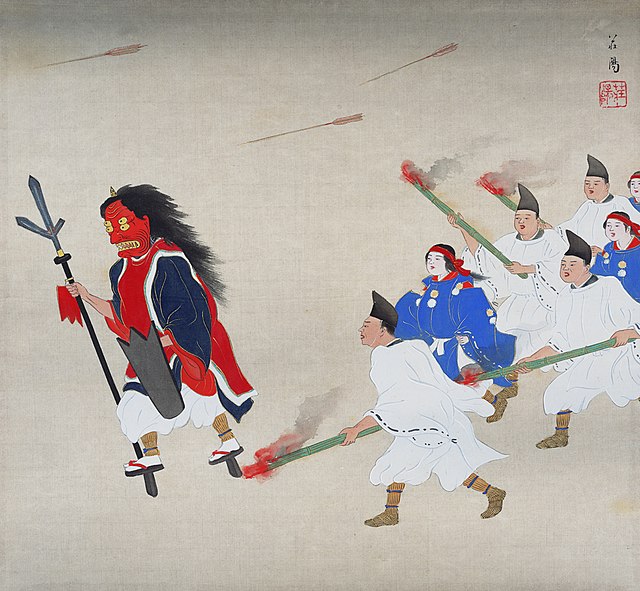
Japanese Shinto ceremonial Hōsōshi at Yoshida Shrine, (1928) painting by Nakajima Sōyō 中島荘陽
Japanese Shinto ceremonial Hōsōshi at Heian Shrine (2010)
In some religions, an exorcist is a person who is believed to be able to cast out the devil or performs the ridding of demons or other supernatural beings who are alleged to have possessed a person, or (sometimes) a building or even an object. An exorcist can be a specially prepared or instructed person including: priest, a nun, a monk, a witch doctor (healer), a shaman, a psychic or a geomancer.
Saint Philip of Agira with the Gospel in his left hand, the symbol of the exorcists, in the May celebrations in his honor at Limina, Sicily
The image of Hanuman at the Hanuman temple in Sarangpur is said to be so powerful that a mere look at it by people affected by evil spirits, drives the evil spirits out of the people affected