Fauxbergé is a term coined to generally describe items that are faking a higher quality or status and in specific terms relates to the House of Fabergé, which was a Russian jewellery firm founded in 1842 in Saint Petersburg and nationalised by the Bolsheviks in 1918. The term was first mentioned in a publication by auctioneer and Fabergé book author Archduke Géza of Austria in his article "Fauxbergé," published in Art and Auction in 1994. He also used it during the exhibition "Fabergé in America" in 1996 and subsequent later ones.
Armand Hammer in 1982.
Ivanov's Fabergé Museum in Baden-Baden (Germany), where both Fabergé and Fauxbergé pieces are on display.
The House of Fabergé was a jewellery firm founded in 1842 in Saint Petersburg, Russia, by Gustav Fabergé, using the accented name Fabergé. Gustav's sons – Peter Carl and Agathon – and grandsons followed him in running the business until the October Revolution in 1917. The firm was famous for designing elaborate jewel-encrusted Fabergé eggs for Russian emperors, and for a range of other work of high quality and intricate detail.
The firm's logo in 1908
Gustav Faberge and his wife, Charlotte Jungstedt, 1890s
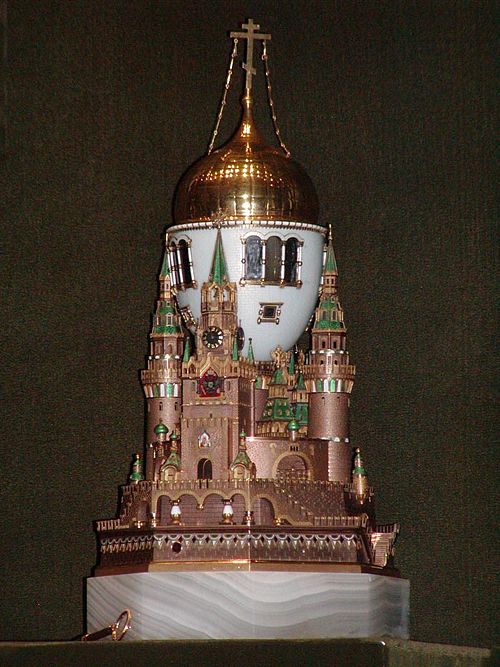
The Moscow Kremlin egg, 1906
Purple amethyst cane handle by Fabergé with white enamel, rose and yellow gold, and a string of pearls. Circa 1890–1898