Fermi surface
Videos
In condensed matter physics, the Fermi surface is the surface in reciprocal space which separates occupied electron states from unoccupied electron states at zero temperature. The shape of the Fermi s

Fig. 1: Fermi surface and electron momentum density of copper in the reduced zone schema measured with 2D ACAR.

Fig. 3: Fermi surface of BSCCO measured by ARPES. The experimental data shown as an intensity plot in yellow-red-black scale. Green dashed rectangle represents the Brillouin zone of the CuO2 plane of BSCCO.
High-temperature superconductivity is superconductivity in materials with a critical temperature above 77 K, the boiling point of liquid nitrogen. They are "high-temperature" only relative to previous
Fermi surface
…space (see reciprocal lattice), and, consequently, the Fermi surface, is the angle-resolved photoemission spectroscopy (ARPES). An example of the Fermi surface of superconducting cuprates measured by ARPES is shown in Figure 3. With positron annihilation it is also possible to determine the Fermi surface as the annihilation process…

A sample of bismuth strontium calcium copper oxide (BSCCO), which is currently one of the most practical high-temperature superconductors. Notably, it does not contain rare earths. BSCCO is a cuprate superconductor based on bismuth and strontium. Thanks to its higher operating temperature, cuprates are now becoming competitors for more ordinary niobium-based superconductors, as well as magnesium diboride superconductors.
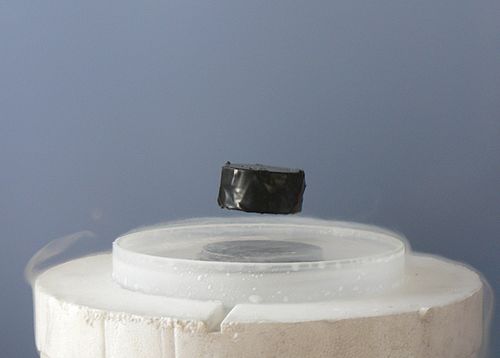
Small magnet levitating above a high-temperature superconductor cooled by liquid nitrogen: this is a case of Meissner effect.