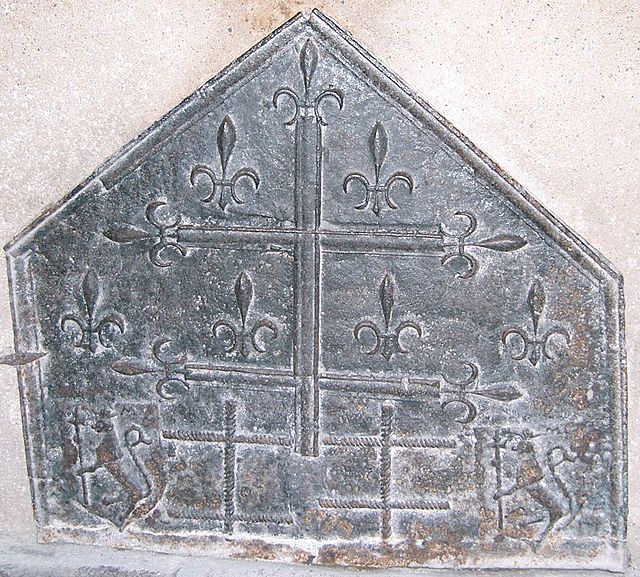
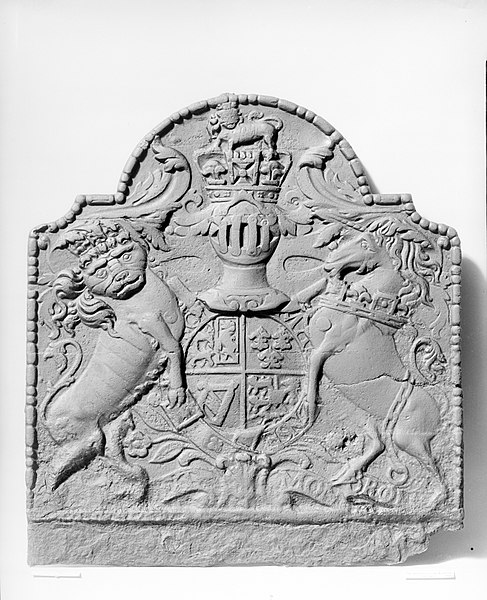
A fireplace fireback is a piece of heavy cast iron, sized in proportion to the fireplace and the fire, which is placed against the back wall of the fireplace.
Fireback in the house of Jeanne d'Arc in Domrémy
Fireback embossed with royal coat-of-arms of Great Britain, cast at Oxford Furnace, New Jersey during the reign of George II
Cast iron is a class of iron–carbon alloys with a carbon content of more than 2% and silicon content around 1–3%. Its usefulness derives from its relatively low melting temperature. The alloying elements determine the form in which its carbon appears: white cast iron has its carbon combined into an iron carbide named cementite, which is very hard, but brittle, as it allows cracks to pass straight through; grey cast iron has graphite flakes which deflect a passing crack and initiate countless new cracks as the material breaks, and ductile cast iron has spherical graphite "nodules" which stop the crack from further progressing.
Pair of English firedogs, 1576. These, with firebacks, were common early uses of cast iron, as little strength in the metal was needed.
Cross section of chilled cast-iron roll
Diorama model of a Han dynasty blast furnace blower
The Iron Lion of Cangzhou, the largest surviving cast-iron artwork from China, 953 AD, Later Zhou period