The flag of Tibet, also known as the "Snow Lion flag", depicts a white snow-covered mountain, a yellow sun with red and blue rays emanating from it, two Tibetan snow lions, a multi-coloured jewel representing Buddhist values, a taijitu and a yellow border around three of its four sides. The flag was used as the national flag of the independent country of Tibet from 1916 until 1951, when Tibet was annexed by the People's Republic of China. It was adopted by the 13th Dalai Lama in 1916 and used in Tibet until the Tibetan uprising of 1959, after which the flag was outlawed in the People's Republic of China. While the Tibetan flag is illegal in Tibet today as it is governed by the PRC as the Tibet Autonomous Region, it continues to be used by the Central Tibetan Administration, the Tibetan government-in-exile based in Dharamshala in India, and by pro-Tibet groups all over the world to show support for human rights in Tibet and Tibetan independence.
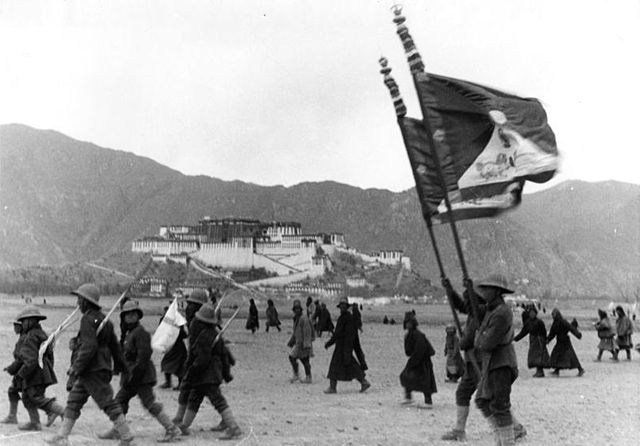
The Tibetan army waves the Tibetan flag at a military parade in Lhasa, 1938.
Two Tibetan delegates (front right) during the Asian Relations Conference in Delhi in 1947 as Mahatma Gandhi speaks (far left). A circular version of the Tibetan flag is seen in front of them along with flags of other participating countries.
The 14th Dalai Lama with Tibet's flag in Zurich, Switzerland 10 April 2010
Tibetan flag in Tibet in the 1940s
The Snow Lion is a celestial animal of Tibet. It is the emblem of Tibet, representing the snowy mountain ranges and glaciers of Tibet, and may also symbolize power and strength, and fearlessness and joy, east and the earth element. It is one of the Four Dignities. It ranges over the mountains, and is commonly pictured as being white with a turquoise mane. In Journey to the West published in 1592, Snow Lion is depicted as one of monster-spirits.
1912 Tibetan stamp with snowlion
Snow Lions decorating a cupboard
Tibetan Snow Lion Dance, Bodhgaya, India
Chinese stone lion at guard the entrance to the Potala Palace


