Fleming valve
Videos
The Fleming valve, also called the Fleming oscillation valve, is a thermionic valve or vacuum tube invented in 1904 by English physicist John Ambrose Fleming as a detector for early radio receivers us

The prototype Fleming valves, built October 1904.

Early commercial Fleming valves used in radio receivers, 1919

Fleming valve schematic from US Patent 803,684.

Valve receiver made by Marconi Co. has two Fleming valves, in case one burns out
Audion
Videos
The Audion is an electronic detecting or amplifying vacuum tube invented by American electrical engineer Lee de Forest as a diode in 1906. Improved, it was patented as the first triode in 1908, consis
Fleming valve
…revolution. After reading Fleming's 1905 paper on his oscillation valve, American engineer Lee de Forest in 1906 created a three-element vacuum tube, the Audion, by adding a wire grid between cathode and anode. It was the first electronic amplifying device, allowing the creation of amplifiers and continuous…

Triode Audion vacuum tube from 1908. The filament (which was also the cathode) was at the lower left inside the tube, but has burned out and is no longer present. The filament's connecting and supporting wires are visible. The plate is at the middle top, and the grid is the serpentine electrode below it. The plate and grid connections leave the tube at the right.

An Audion radio receiver by de Forest. The Audion tubes were mounted upside down to prevent the delicate filaments from sagging and touching the grids. This receiver provided the ability to choose operation of either one of the two provided detector tubes.
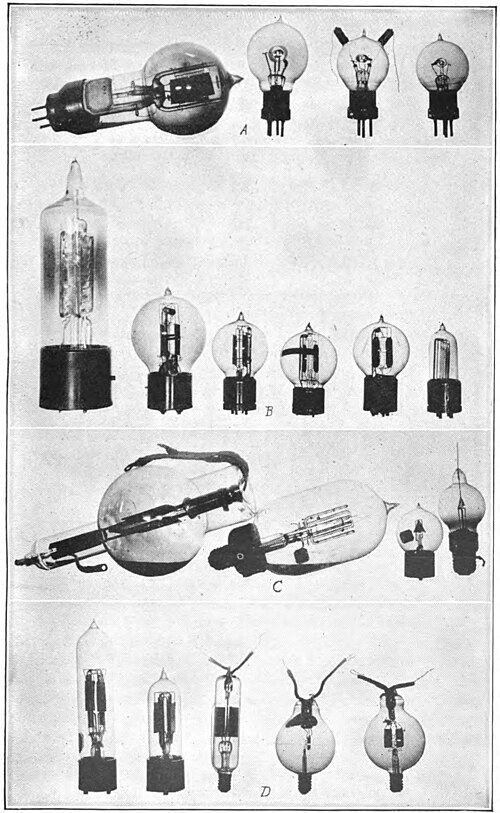
Audions and early triodes developed from them, 1918 Bottom row (D): De Forest Audions and oscillaudions Third row (C): Pliotrons, developed at General Electric by Langmuir Second row (B): triodes developed at Western Electric which bought the rights from de Forest in 1913. Top row (A): French triodes. The French government gained the right to manufacture Audions in 1912 when de Forest failed to renew his French patents for lack of $125.

The first Audion AM radio transmitter, built by Lee de Forest and announced April, 1914