Flight control surfaces
Videos
Flight control surfaces are aerodynamic devices allowing a pilot to adjust and control the aircraft's flight attitude. The primary function of these is to control the aircraft's movement along the thr

KLM Fokker 70, showing position of flap and liftdumper flight controls. The liftdumpers are the lifted cream-coloured panels on the wing upper surface (in this picture there are five on the right wing). The flaps are the large drooped surfaces on the trailing edge of the wing.
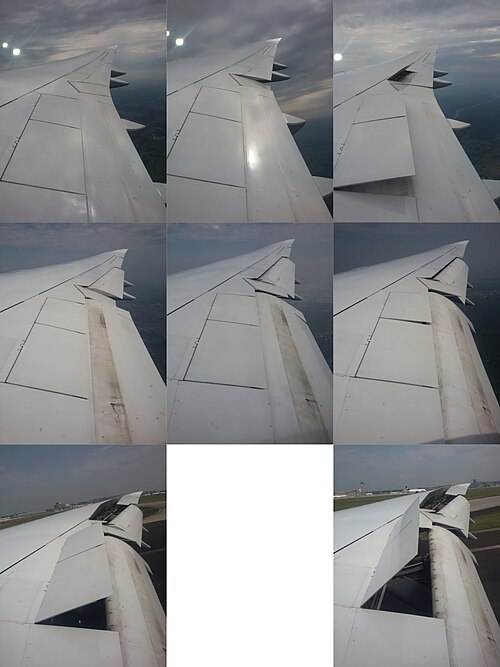
Wing trailing edge flight control surfaces of a Boeing 747-8. Top left: All surfaces at neutral position; Top middle: Right aileron is lowered; Top right: spoilers raised during flight; Middle row: Fowler flaps extended (left), extended more (middle), hinged with inboard slotted part hinged even more (right); Bottom row: spoilers raised during landing

Air brakes on the rear fuselage of a Eurowings BAe 146-300

Mass balance protruding from an aileron used to suppress flutter
Elevator (aeronautics)
Videos
Elevators are flight control surfaces, usually at the rear of an aircraft, which control the aircraft's pitch, and therefore the angle of attack and the lift of the wing. The elevators are usually hin
Flight control surfaces
…of effective flight controls allowed stable flight. A conventional fixed-wing aircraft uses three primary flight control surfaces– aileron, rudder and elevator to control the roll, yaw, and pitch respectively. Secondary flight control surfaces might include spoiler, flaps, and slats on the wings. The main…

Elevator and pitch trim tab of a light aircraft

The elevator on this Currie Wot biplane is nearly touching the grass at the rear of this aircraft