There is evidence that the formation of the Solar System began about 4.6 billion years ago with the gravitational collapse of a small part of a giant molecular cloud. Most of the collapsing mass collected in the center, forming the Sun, while the rest flattened into a protoplanetary disk out of which the planets, moons, asteroids, and other small Solar System bodies formed.

Artist's conception of a protoplanetary disk

Pierre-Simon Laplace, one of the originators of the nebular hypothesis

Hubble image of protoplanetary discs in the Orion Nebula, a light-years-wide stellar nursery probably very similar to the primordial nebula from which the Sun formed

Meteor Crater in Arizona. Created 50,000 years ago by an impactor about 50 metres (160 ft) across, it shows that the accretion of the Solar System is not over.
Moon
Videos
The Moon is Earth's only natural satellite. It orbits at an average distance of 384,400 km (238,900 mi), about 30 times the diameter of Earth. Over time Earth's gravity has caused tidal locking, causing the same side of the Moon to always face Earth. Because of this, the lunar day and the lunar month are the same length, at 29.5 Earth days. The Moon's gravitational pull – and to a lesser extent, the Sun's – are the main drivers of Earth's tides.

Near side of the Moon, lunar north pole at top

Size comparison of the main moons of the Solar System with Earth to scale. Nineteen moons are large enough to be round, several having subsurface oceans and one, Titan, having a considerable atmosphere.
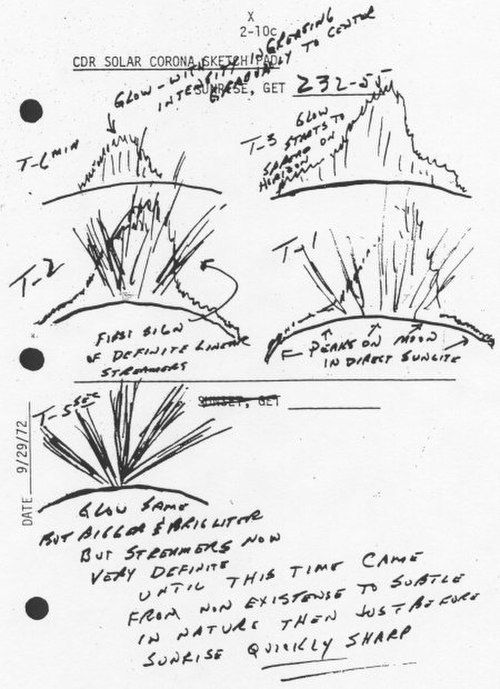
The thin lunar atmosphere is visible on the Moon's surface at sunrise and sunset with the lunar horizon glow and lunar twilight rays, like Earth's crepuscular rays. This Apollo 17 sketch depicts the glow and rays among the general zodiacal light.

Gene Cernan with lunar dust stuck on his suit. Lunar dust is highly abrasive and can cause damage to human lungs, nervous, and cardiovascular systems.