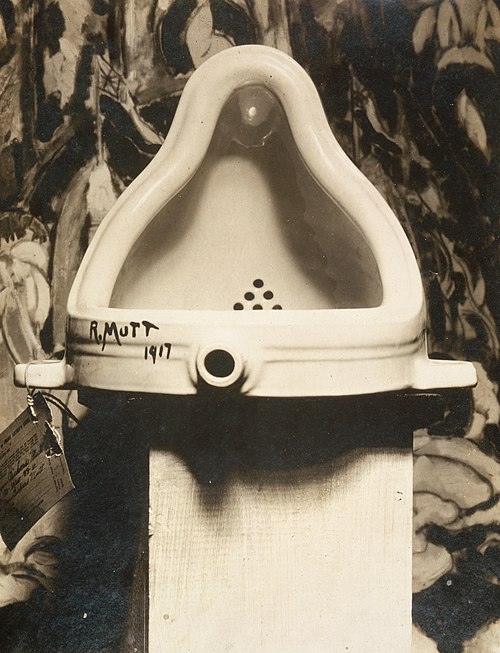
A found object, or found art, is art created from undisguised, but often modified, items or products that are not normally considered materials from which art is made, often because they already have a non-art function. Pablo Picasso first publicly utilized the idea when he pasted a printed image of chair caning onto his painting titled Still Life with Chair Caning (1912). Marcel Duchamp is thought to have perfected the concept several years later when he made a series of ready-mades, consisting of completely unaltered everyday objects selected by Duchamp and designated as art. The most famous example is Fountain (1917), a standard urinal purchased from a hardware store and displayed on a pedestal, resting on its back. In its strictest sense the term "ready-made" is applied exclusively to works produced by Marcel Duchamp, who borrowed the term from the clothing industry while living in New York, and especially to works dating from 1913 to 1921.
Alphonse Allais, Des souteneurs encore dans la force de l'âge et le ventre dans l'herbe boivent de l'absinthe, carnage curtain, before 1897.
An Oak Tree by Michael Craig-Martin; 1973
Junk art at Oak Street Beach
Pop art is an art movement that emerged in the United Kingdom and the United States during the mid- to late-1950s. The movement presented a challenge to traditions of fine art by including imagery from popular and mass culture, such as advertising, comic books and mundane mass-produced objects. One of its aims is to use images of popular culture in art, emphasizing the banal or kitschy elements of any culture, most often through the use of irony. It is also associated with the artists' use of mechanical means of reproduction or rendering techniques. In pop art, material is sometimes visually removed from its known context, isolated, or combined with unrelated material.
Andy Warhol, Campbell's Tomato Juice Box, 1964. Synthetic polymer paint and silkscreen ink on wood, 10 inches × 19 inches × 9½ inches (25.4 × 48.3 × 24.1 cm), Museum of Modern Art, New York City
Charles Demuth, I Saw the Figure 5 in Gold 1928, collection of the Metropolitan Museum of Art, New York City
Richard Hamilton's collage Just what is it that makes today's homes so different, so appealing? (1956) is one of the earliest works to be considered "pop art".