Fountain (Duchamp)
Videos
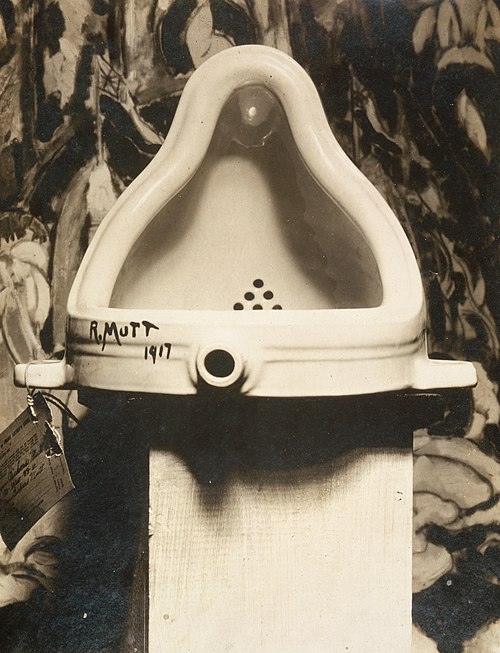
Fountain was a readymade sculpture attributed to Marcel Duchamp in 1917, consisting of a porcelain urinal signed "R. Mutt". The work is regarded by art historians and theorists of the avant-garde as a
Marcel Duchamp Fountain, 1917, photograph by Alfred Stieglitz at 291 art gallery following the 1917 Society of Independent Artists exhibit, with entry tag visible. The backdrop is The Warriors by Marsden Hartley.

Eljer Co. Highest Quality Two-Fired Vitreous China Catalogue 1918 Bedfordshire No. 700

The urinal suspended in Marcel Duchamp's studio at 33 West 67th Street, New York, 1917–1918. Two other readymades by Duchamp are visible in the photograph: In Advance of the Broken Arm (1915), and Hat rack (Porte-chapeau) (1917). This photograph is reproduced at the top right of one of the plates from Duchamp's La Boîte-en-valise.

The Blind Man, No. 2, New York, 1917, p. 5, by Louise Norton. The article included a photo of the piece and a letter by Alfred Stieglitz, and writings by Louise Norton, Beatrice Wood and Walter Arensberg.
Readymades of Marcel Duchamp
Videos
The readymades of Marcel Duchamp are ordinary manufactured objects that the artist selected and modified, as an antidote to what he called "retinal art". By simply choosing the object and repositionin
Fountain (Duchamp)
…Fountain was a readymade sculpture attributed to Marcel Duchamp in 1917, consisting of a porcelain urinal signed "R. Mutt". The work is regarded by art historians and theorists…

Marcel Duchamp's studio at 33 West 67th Street, New York City, 1917–18. Shown to the left is the 2nd version of Bicycle Wheel, 1916–17. The original 1913 version and this 2nd version are lost. The coatrack, titled Trap (Trébuchet), 1917, is on the floor, lower left.

Marcel Duchamp, 1919, L.H.O.O.Q., a parody of the Mona Lisa with a goatee and moustache

Man Ray, 1920 21, Portrait of Marcel Duchamp, gelatin silver print, Yale University Art Gallery