François Caron
Videos
François Caron was a French Huguenot refugee to the Netherlands who served the Dutch East India Company for 30 years, rising from cook's mate to the director-general at Batavia (Jakarta), only one grade below governor-general. He retired from the VOC in 1651, and was later recruited to become director-general of the newly formed French East Indies Company in 1665 until his death in 1673.

The Dutch VOC trading factory in Hirado. 17th-century engraving.

"A True Description of the Mighty Kingdoms of Japan and Siam" by François Caron, German Edition, 1663.

Illustration of the Siege of Osaka, from Caron's book: "The Burning of Osaka Castle"
VOC opperhoofden in Japan
Videos
VOC opperhoofden in Japan were the chief traders of the Dutch East India Company in Japan during the period of the Tokugawa shogunate, also known as the Edo period.
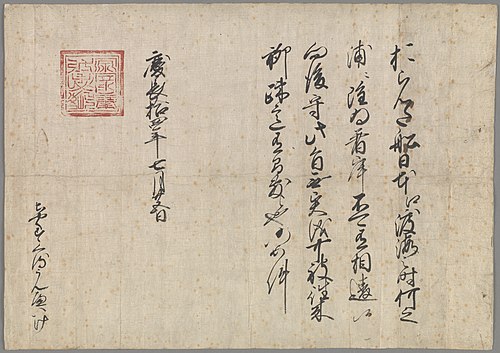
The "trade pass" (Dutch: handelspas) issued in the name of Tokugawa Ieyasu. The text commands: "Dutch ships are allowed to travel to Japan, and they can disembark on any coast, without any reserve. From now on this regulation must be observed, and the Dutch left free to sail where they want throughout Japan. No offenses to them will be allowed, such as on previous occasions" – dated August 24, 1609 (Keichō 14, 25th day of the 6th month); n.b., the
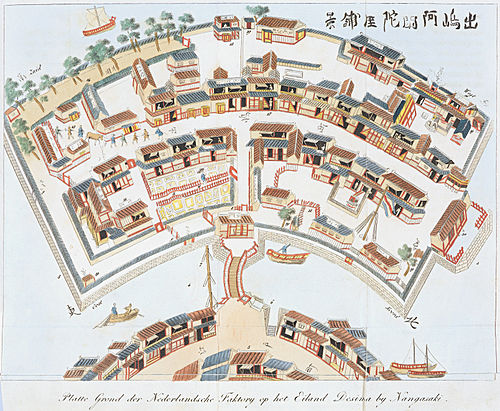
An imagined bird's-eye view of Dejima's layout and structures. Note the island's fan-shape. Japanese wood-block print made by Toshimaya Bunjiemon in 1780.

Hendrik Doeff and a Balinese servant in Dejima, Japanese painting