Frequency modulation
Videos
Frequency modulation is a signal modulation technique used in electronic communication, originally for transmitting messages with a radio wave. In frequency modulation a carrier wave is varied in its
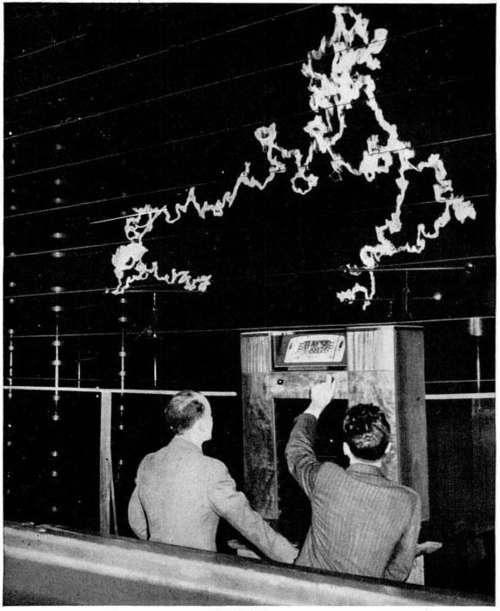
FM has better noise (RFI) rejection than AM, as shown in this dramatic New York publicity demonstration by General Electric in 1940. The radio has both AM and FM receivers. With a million-volt electric arc as a source of interference behind it, the AM receiver produced only a roar of static, while the FM receiver clearly reproduced a music program from Armstrong's experimental FM transmitter W2XMN in New Jersey.

Frequency spectrum and waterfall plot of a 146.52 MHz carrier, frequency modulated by a 1,000 Hz sinusoid. The modulation index has been adjusted to around 2.4, so the carrier frequency has small amplitude. Several strong sidebands are apparent; in principle an infinite number are produced in FM but the higher-order sidebands are of negligible magnitude.

An American FM radio transmitter at WEDG in Buffalo, New York
Signal modulation
Videos
Signal modulation is the process of varying one or more properties of a periodic waveform in electronics and telecommunication for the purpose of transmitting information.
Frequency modulation
…Frequency modulation (FM) is a signal modulation technique used in electronic communication, originally for transmitting messages with a radio wave. In frequency modulation a carrier wave is varied…

Waterfall plot of a 146.52 MHz radio carrier, with amplitude modulation by a 1,000 Hz sinusoid. Two strong sidebands at + and - 1 kHz from the carrier frequency are shown.