Frohnauer Hammer
Videos
The Frohnauer Hammer is an historic hammer mill in Frohnau, a village in the municipality of Annaberg-Buchholz in the Ore Mountains of southeast Germany. The mill is an important witness to proto-industrial development in the Ore Mountains. Of the once-numerous hammer mills only three others remain working in Saxony: the Dorfchemnitz Iron Hammer Mill, the Grünthal Copper Hammer Mill and the Freibergsdorf Hammer Mill.
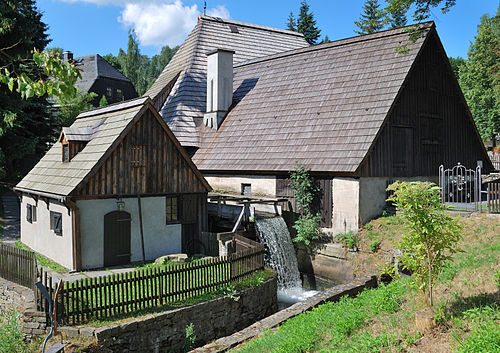
Frohnauer Hammer Technology Museum - exterior view of the smithy

The mansion, today a restaurant. On the upper floor there is a bobbin lace room open to visitors

The mansion of the Frohnauer Hammer Mill in 1965

Interior of the smithy
Trip hammer
Videos
A trip hammer, also known as a tilt hammer or helve hammer, is a massive powered hammer. Traditional uses of trip hammers include pounding, decorticating and polishing of grain in agriculture. In mining, trip hammers were used for crushing metal ores into small pieces, although a stamp mill was more usual for this. In finery forges they were used for drawing out blooms made from wrought iron into more workable bar iron. They were also used for fabricating various articles of wrought iron, latten, steel and other metals.

A 1960s trip hammer placed at Trattenbach village, Lower Austria

The same trip hammer in operation, shaping a folding knife at the strike area

A water powered trip hammer from the Nong Shu by Wang Zhen (fl. 1290–1333)

Hydrodynamic powered trip hammer set, illustration from the Tiangong Kaiwu encyclopedia of 1637, written by Song Yingxing (1587–1666)