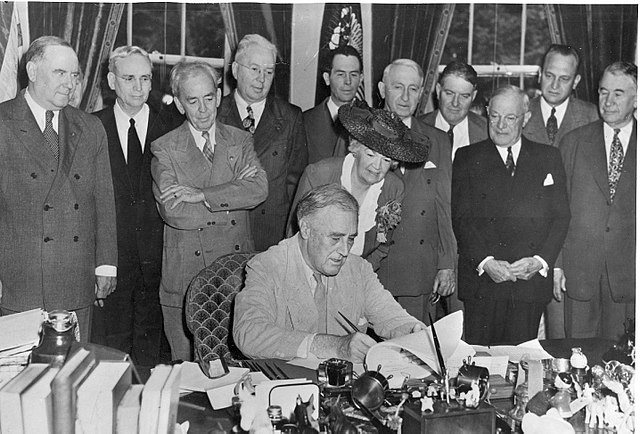
The G.I. Bill, formally known as the Servicemen's Readjustment Act of 1944, was a law that provided a range of benefits for some of the returning World War II veterans. The original G.I. Bill expired in 1956, but the term "G.I. Bill" is still used to refer to programs created to assist American military veterans.
President Roosevelt signs the G.I. Bill into law on June 22, 1944.
Don A. Balfour was "the first recipient of the 1944 GI Bill." Veterans Administration letter to George Washington University.
A government poster informing soldiers about the G.I. Bill
The American Legion, commonly known as the Legion, is a patriotic organization of U.S. war veterans headquartered in Indianapolis, Indiana. It comprises state, U.S. territory, and overseas departments, in turn, made up of local posts. It was established in March 1919 at Paris, France, by officers and men of the American Expeditionary Forces (A.E.F.). In September 1919, it was chartered by the U.S. Congress.
American Legion National Headquarters Indianapolis, Indiana, United States
The Paris Caucus
Indiana World War Memorial Plaza, home of the National Headquarters
Woodrow Wilson, 28th President of the United States