Garden of Eden
Videos
The Garden of Eden, also called Garden of God or the Paradise, is the biblical paradise described in Genesis 2–3 and Ezekiel 28 and 31.

The Garden of Eden with the Fall of Man by Jan Brueghel the Elder and Pieter Paul Rubens, c. 1615, depicting both domestic and exotic wild animals such as tigers, parrots, and ostriches co-existing in the garden

Expulsion from Paradise, painting by James Tissot, c. 1896–1902

The Expulsion illustrated in the English Junius manuscript, c. 1000 CE

The Garden of Eden in the left panel of Bosch's The Garden of Earthly Delights
Tree of life
Videos
The tree of life is a fundamental archetype in many of the world's mythological, religious, and philosophical traditions. It is closely related to the concept of the sacred tree. The tree of the knowl
Garden of Eden
…of the Tower of Babel, the story of Eden echoes the Mesopotamian myth of a king, as a primordial man, who is placed in a divine garden to guard the tree of life. Scholars note that the Eden narrative shows parallels with aspects of Solomon's Temple and Jerusalem, attesting to its nature as a sacred place…
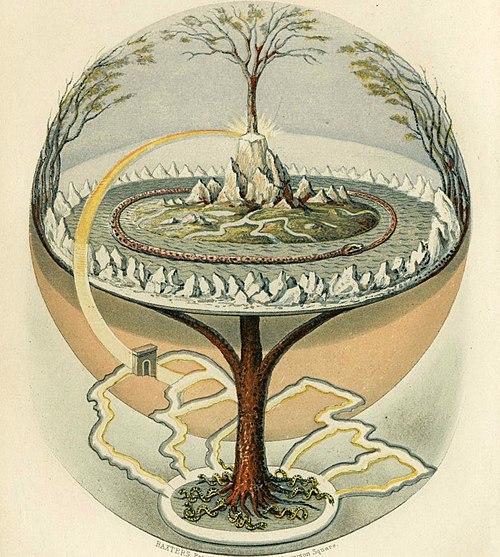
An 1847 depiction of the Norse Yggdrasil as described in the Icelandic Prose Edda by Oluf Olufsen Bagge

Confronted animals, here ibexes, flank a tree of life, a very common motif in the art of the ancient Near East and Mediterranean

The Urartian tree of life

Goddess Nut as a sycamore tree assisting a soul in the afterlife.