Gauss's principle of least constraint
The principle of least constraint is one variational formulation of classical mechanics enunciated by Carl Friedrich Gauss in 1829, equivalent to all other formulations of analytical mechanics. Intuitively, it says that the acceleration of a constrained physical system will be as similar as possible to that of the corresponding unconstrained system.
Carl Friederich Gauss
Heinrich Hertz
D'Alembert's principle, also known as the Lagrange–d'Alembert principle, is a statement of the fundamental classical laws of motion. It is named after its discoverer, the French physicist and mathematician Jean le Rond d'Alembert, and Italian-French mathematician Joseph Louis Lagrange. D'Alembert's principle generalizes the principle of virtual work from static to dynamical systems by introducing forces of inertia which, when added to the applied forces in a system, result in dynamic equilibrium.
Traité de dynamique by Jean Le Rond d'Alembert, 1743. In it, the French scholar enunciated the principle of the quantity of movement, also known as "D'Alembert's principle".
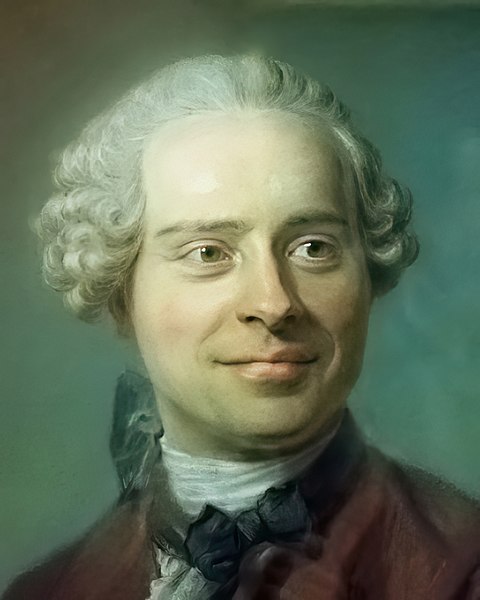
Jean d'Alembert (1717–1783)