Geminga is a gamma ray and x-ray pulsar source thought to be a neutron star approximately 250 parsecs from the Sun in the constellation Gemini.
Geminga as seen by Chandra and Spitzer Credit: X-ray: NASA/CXC/PSU/B. Posselt et al; Infrared: NASA/JPL–Caltech
left: Geminga, IC 443 and the Crab Nebula. right: The halo around the pulsar Geminga seen by Fermi after removing bright sources
Position of Geminga in the Milky Way gamma-ray sky. Credit: NASA/DOE/International LAT Team
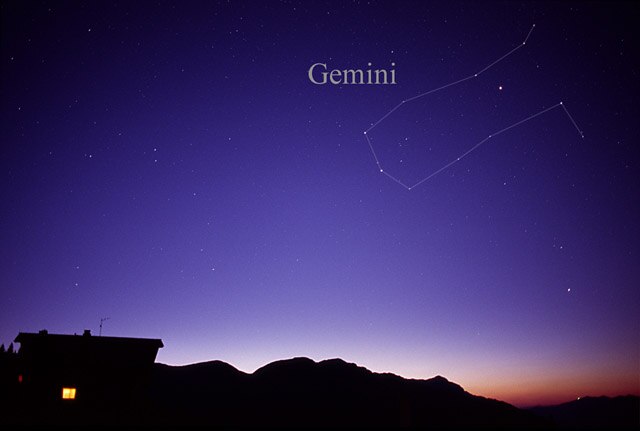
Gemini is one of the constellations of the zodiac and is located in the northern celestial hemisphere. It was one of the 48 constellations described by the 2nd century AD astronomer Ptolemy, and it remains one of the 88 modern constellations today. Its name is Latin for twins, and it is associated with the twins Castor and Pollux in Greek mythology. Its old astronomical symbol is (♊︎).
The constellation Gemini as it can be seen with the unaided eye, with added connecting lines.
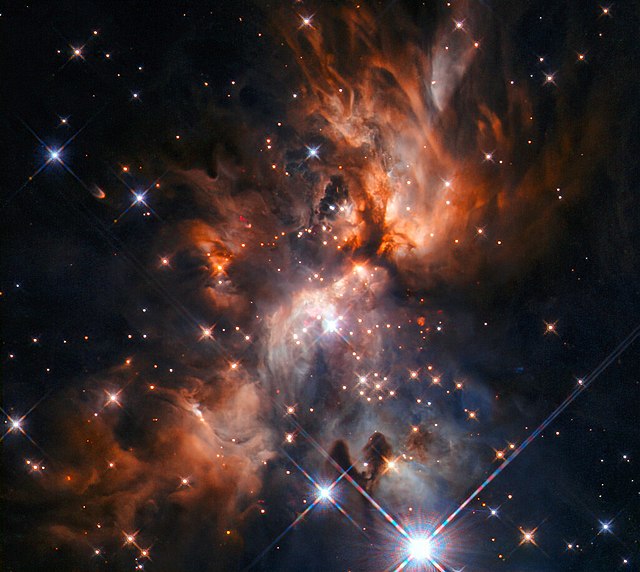
AFGL 5180 - Through the Clouds.
Gemini as depicted in Urania's Mirror, a set of constellation cards published in London c.1825.
Sculpture showing Castor and Pollux, the legend behind the third astrological sign in the Zodiac and the constellation of Gemini