Gentry
Videos
Gentry are "well-born, genteel and well-bred people" of high social class, especially in the past. Gentry, in its widest connotation, refers to people of good social position connected to landed estat

Cleric, knight, and peasant archetypes represent the virtues of prudence, fortitude, and temperance, respectively. In classical antiquity and Christendom, prudence and fortitude were seen as the cardinal virtues that should govern society.

This part of a 12th-century Swedish tapestry has been interpreted to show, from left to right, the one-eyed Odin, the hammer-wielding Thor and Freyr. This triad corresponds closely to the trifunctional division: Odin is the patron of priests and magicians, Thor of warriors, and Freyr of fertility and farming.
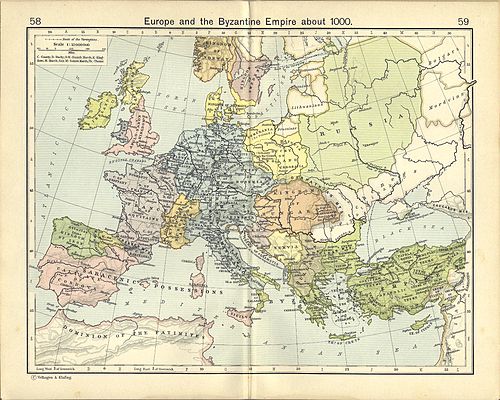
Europe and the Byzantine Empire 1000 AD

The Three Estates of Christendom by Bartholomäus Bruyn c. 1535
A peerage is a form of crown distinction, with peerages in the United Kingdom comprising both hereditary and lifetime titled appointments of various ranks, which form both a constituent part of the le
Gentry
…Kingdom gentry specifically refers to the landed gentry: the majority of the land-owning social class who typically had a coat of arms but did not hold a peerage. The adjective "patrician" ("of or like a person of high social rank") describes comparable elite groups in other analogous traditional social elite…

Wax impression of a Great Seal of the Realm (that used 1953–2001), which is affixed to all letters patent creating new peerages

The House of Lords showing government, opposition and the cross benches

The Lord Speaker presiding from the woolsack

Alec Douglas-Home (c.1963), the last Prime Minister of the United Kingdom to serve from the House of Lords