Geography of Mauritania
Videos
Mauritania, a country in the Western Region of the continent of Africa, is generally flat, its 1,030,700 square kilometres forming vast, arid plains broken by occasional ridges and clifflike outcroppi
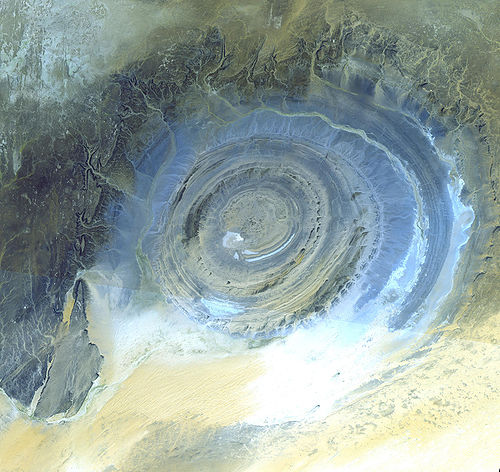
Guelb er Richat structure. With a diameter of almost 50 kilometers (31 mi), it has become a landmark for Space Shuttle crews. Initially interpreted as a meteorite impact structure because of its high degree of circularity, it is now thought to be merely a symmetrical uplift (circular anticline) that has been laid bare by erosion. Paleozoic quartzites form the resistant beds outlining the structure.

Dust plume off Mauritania.

The Passe de Djouk, near Guerou; an increasingly arid area

Oasis of Mhaïreth
Kediet ej Jill
Videos
Kediet ej Jill is a mountain in Tiris Zemmour, Mauritania, with the city of Zouérat on its east and Fderick at west.
Geography of Mauritania
…the smaller peaks are called Guelbs and the larger ones Kedias. The concentric Guelb er Richat is a prominent feature of the north-central region. Kediet ej Jill, near the city of Zouîrât, has an elevation of 915 metres or 3,002 feet and is the highest peak. Approximately three-fourths of Mauritania is desert…

Kediet ej Jill in 2022