Geomicrobiology
Videos
Geomicrobiology is the scientific field at the intersection of geology and microbiology and is a major subfield of geobiology. It concerns the role of microbes on geological and geochemical processes and effects of minerals and metals to microbial growth, activity and survival. Such interactions occur in the geosphere, the atmosphere and the hydrosphere. Geomicrobiology studies microorganisms that are driving the Earth's biogeochemical cycles, mediating mineral precipitation and dissolution, and sorbing and concentrating metals. The applications include for example bioremediation, mining, climate change mitigation and public drinking water supplies.
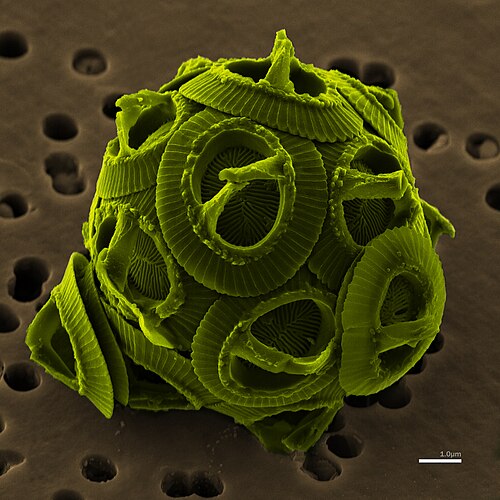
The coccolithophore Gephyrocapsa oceanica may become an important carbon sink as the acidity of the ocean increases.

Two scientists prepare samples of soil mixed with oil to test a microbe's ability to clean up contaminated soil.

Paleoarchean (3.35-3.46 billion years old) stromatolite from Western Australia.

The colors of Grand Prismatic Spring in Yellowstone National Park are due to mats of thermophilic bacteria.
Geobiology
Videos
Geobiology is a field of scientific research that explores the interactions between the physical Earth and the biosphere. It is a relatively young field, and its borders are fluid. There is considerable overlap with the fields of ecology, evolutionary biology, microbiology, paleontology, and particularly soil science and biogeochemistry. Geobiology applies the principles and methods of biology, geology, and soil science to the study of the ancient history of the co-evolution of life and Earth as well as the role of life in the modern world. Geobiologic studies tend to be focused on microorganisms, and on the role that life plays in altering the chemical and physical environment of the pedosphere, which exists at the intersection of the lithosphere, atmosphere, hydrosphere and/or cryosphere. It differs from biogeochemistry in that the focus is on processes and organisms over space and time rather than on global chemical cycles.

The colorful microbial mats of Grand Prismatic Spring in Yellowstone National Park, USA. The orange mats are composed of Chloroflexia, "Cyanobacteria", and other organisms that thrive in the 70˚C water. Geobiologists often study extreme environments like this because they are home to extremophilic organisms. It has been hypothesized that these environments may be representative of early Earth.

A microbial mat in White Creek, Yellowstone National Park, USA. Note the conical microstructure of the bacterial communities. These are hypothesized to be a living analogue of ancient fossil stromatolites. Each cone has an oxygen gas bubble on top, the product of oxygenic photosynthesis by cyanobacteria in the multi-species microbial mats.

Banded iron formation (BIF), Hammersley Formation, Western Australia

Modern, living stromatolites in Shark Bay, Australia. Shark Bay is one of the few places in the world where stromatolites can be seen today, though they were likely common in ancient shallow seas before the rise of metazoan predators.