George Washington in the French and Indian War
George Washington's military experience began in the French and Indian War with a commission as a major in the militia of the British Province of Virginia. In 1753 Washington was sent as an ambassador from the British crown to the French officials and Indians as far north as present-day Erie, Pennsylvania. The following year he led another expedition to the area to assist in the construction of a fort at present-day Pittsburgh, Pennsylvania. Before reaching that point, he and some of his men, along with Mingo allies led by Tanacharison, ambushed a French scouting party. Its leader was killed, although the exact circumstances of his death were disputed. This peacetime act of aggression is seen as one of the first military steps leading to the global Seven Years' War. The French responded by attacking fortifications Washington erected following the ambush, forcing his surrender. Released on parole, Washington and his troops returned to Virginia.
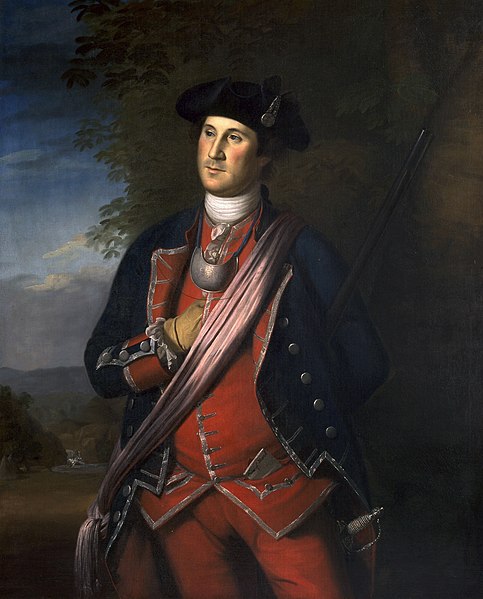
This portrait of Washington was painted in 1772 by Charles Willson Peale, and shows Washington in uniform as a colonel of the Virginia Regiment. The original hangs in Lee Chapel at Washington and Lee University in Lexington, Virginia. It is the earliest known depiction of Washington.
George Washington (left) meeting with French military commander Jacques Legardeur de Saint-Pierre in 1753
A recreation of Fort Necessity
Major-General Braddock's death at the Battle of the Monongahela, July 9, 1755.
The French and Indian War (1754–1763) was a theater of the Seven Years' War, which pitted the North American colonies of the British Empire against those of the French, each side being supported by various Native American tribes. At the start of the war, the French colonies had a population of roughly 60,000 settlers, compared with 2 million in the British colonies. The outnumbered French particularly depended on their native allies.
The coureurs des bois were French-Canadian fur traders, who did business with natives throughout the Mississippi and St. Lawrence watershed.
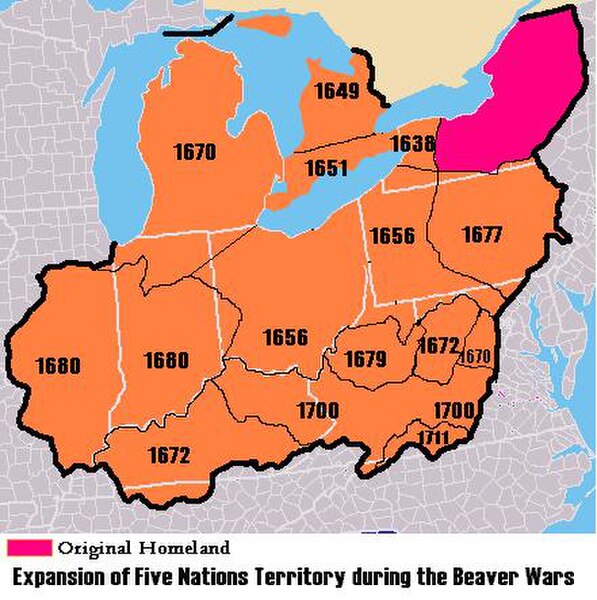
Iroquois expansion, 1711. By the mid-18th century, the Iroquois Confederacy had expanded from Upstate New York to the Ohio Country.
The Cherokee, c. 1762. The Cherokee were subject to diplomatic efforts from the British and French to gain their support or neutrality in the event of a conflict.
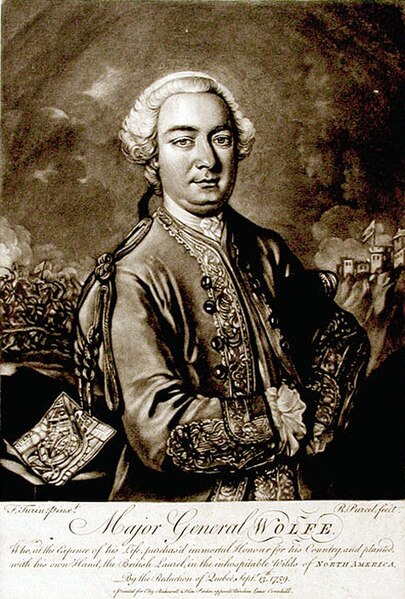
General James Wolfe, British commander