Geotechnical investigation
Videos
Geotechnical investigations are performed by geotechnical engineers or engineering geologists to obtain information on the physical properties of soil earthworks and foundations for proposed structure

A USBR soil scientist advances a Giddings Probe direct push soil sampler.

A soil sample recovered from a test boring using a split spoon sampler

Several hydrometers in use to record the distribution of fine particles in soil samples
Cone penetration test
Videos
The cone penetration or cone penetrometer test is a method used to determine the geotechnical engineering properties of soils and delineating soil stratigraphy. It was initially developed in the 1950s
Geotechnical investigation
…this is used to estimate certain soil properties. This is a simple test method and usually needs backing up with lab data to get a good correlation. A cone penetration test (CPT) is performed using an instrumented probe with a conical tip, pushed into the soil hydraulically at a constant rate. A basic CPT instrument reports…
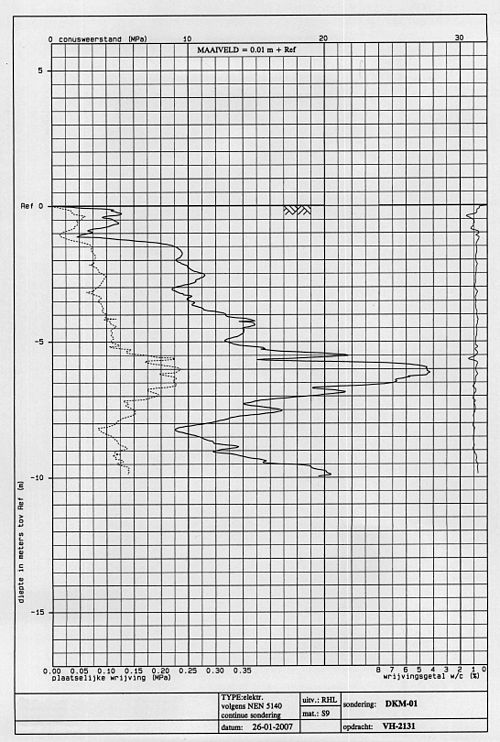
The result of a cone penetration test: resistance and friction on the left, friction ratio (%) on the right.