Germ theory of disease
Videos
The germ theory of disease is the currently accepted scientific theory explaining the cause of infectious diseases. It states that microorganisms known as pathogens or "germs" can cause disease. These

Scanning electron microscope image of Vibrio cholerae, the bacterium that causes cholera
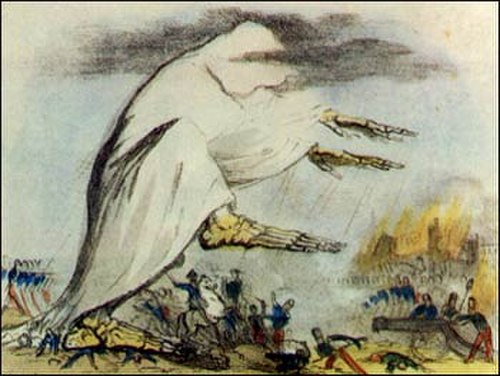
A representation by Robert Seymour of the cholera epidemic depicts the spread of the disease in the form of poisonous air.

Louis Pasteur's spontaneous generation experiment illustrates that liquid nutrients are spoiled by particles in the air rather than the air itself. These results of these experiments supported the germ theory of disease.
Girolamo Fracastoro
Videos
Girolamo Fracastoro was an Italian physician, poet, and scholar in mathematics, geography and astronomy. Fracastoro subscribed to the philosophy of atomism, and rejected appeals to hidden causes in sc
Germ theory of disease
…are disease-causing agents that can pass from one individual to another, across multiple domains of life. Basic forms of germ theory were proposed by Girolamo Fracastoro in 1546, and expanded upon by Marcus von Plenciz in 1762. However, such views were held in disdain in Europe, where Galen's miasma theory remained…

Portrait of Girolamo Fracastoro by Titian, c.1528

The statue in its context

The statue with the inscription

Hieronymi Fracastorii Poemata Omnia (1718)