German bombing of Rotterdam
Videos
In 1940, Rotterdam was subjected to heavy aerial bombardment by the Luftwaffe during the German invasion of the Netherlands during the Second World War. The objective was to support the German troops

Rotterdam's city centre after the bombing. The heavily damaged (now restored) Grote or Sint-Laurenskerk (St. Lawrence church) stands out as the only remaining building that is reminiscent of Rotterdam's medieval architecture. The photo was taken after the removal of all debris.

A painting of Rotterdam in 1895

Rotterdam's burning northern suburbs after the bombing.

Rotterdam's city centre after the bombing in 1940. The heavily damaged (now restored) St. Lawrence church stands out as the only remaining building that is reminiscent of Rotterdam's medieval architecture. (Agfacolor)
Carpet bombing
Videos
Carpet bombing, also known as "saturation bombing" and "obliteration bombing", is a large area bombardment done in a progressive manner to inflict damage in every part of a selected area of land. Carp
German bombing of Rotterdam
…specifically for a precision raid. Schmidt's request for air support reached the staff of Luftflotte 2 in Berlin. Instead of a precision bombing, a carpet bombing by Heinkel He 111 bombers was carried out, with only a Gruppe of Stukas focusing on some strategic targets. The carpet bombing had been ordered by…
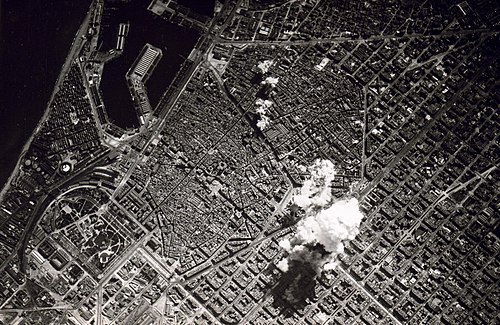
The first carpet bombing from air in history was the Bombing of Barcelona. 1,300 people were killed in 3 days, 16–18 March 1938

Wesel was 97% destroyed before it was finally taken by Allied troops in 1945

Photo of bombing of Waegwan, 1950