The Germanic SS was the collective name given to paramilitary and political organisations established in parts of German-occupied Europe between 1939 and 1945 under the auspices of the Schutzstaffel (SS). The units were modeled on the Allgemeine SS in Nazi Germany and established in Belgium, Denmark, the Netherlands, and Norway—population groups who were considered to be especially "racially suitable" by the Nazis. They typically served as local security police augmenting German units of the Gestapo, Sicherheitsdienst (SD), and other departments of the German Reich Security Main Office (RSHA), rendering them culpable for their participation in Nazi atrocities.
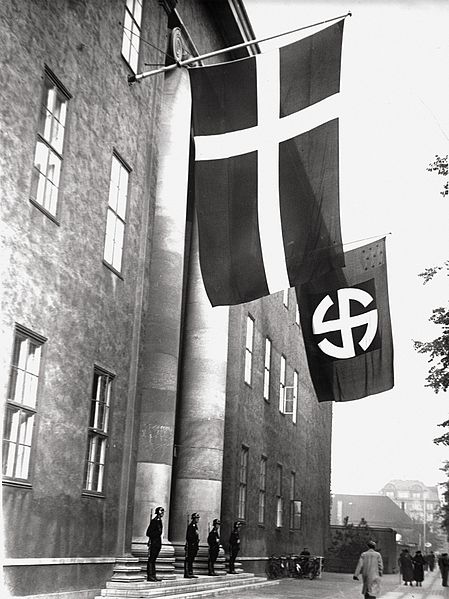
Headquarters of the Schalburg Corps in Copenhagen, Denmark, c.1943.
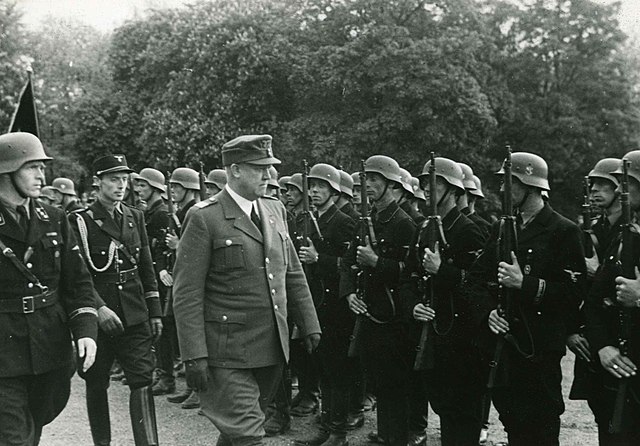
Vidkun Quisling inspects the Germanske SS Norge on the Palace Square in Oslo, Norway
The Allgemeine SS was a major branch of the Schutzstaffel (SS) paramilitary forces of Nazi Germany; it was managed by the SS Main Office (SS-Hauptamt). The Allgemeine SS was officially established in the autumn of 1934 to distinguish its members from the SS-Verfügungstruppe, which later became the Waffen-SS, and the SS-Totenkopfverbände, which were in charge of the Nazi concentration camps and extermination camps. SS formations committed many war crimes against civilians and allied servicemen.
Reichsführer Heinrich Himmler leads an SS ceremony on the anniversary of the death of Heinrich I at Quedlinburg, July 1938
1939 photograph; shown from left to right are Franz Josef Huber, Arthur Nebe, Heinrich Himmler, Reinhard Heydrich and Heinrich Müller. According to the archival caption, these men are planning the investigation of the bomb assassination attempt on Adolf Hitler of 8 November 1939 in Munich.
Jews from Carpathian Ruthenia arriving at Auschwitz concentration camp, 1944