Geuzen medals
Videos
Photos
Geuzen medals, Beggars' or Sea Beggars' medals were minted early in the Dutch Revolt and during the first half of the 16th-century Eighty Years' War. During that period, many medals, tokens and jetons with a political message were minted. The earliest Geuzen medals date from the mid-16th century to 1577.

Silver medal commemorating the Capture of Brielle in 1572 by the Sea Beggars

Geuzen medal by Jacques Jonghelinck, cast silver, original gilt, 1566; possibly the first Geuzen medal

Geuzen medal, cast silver, original gilt, 1566, maker unknown

Hoorne's gold medal, illustrated in G. van der Meer's article on page 92 of the May-June 1980 issue of de Beeldenaar
Medal
Videos
Photos
A medal or medallion is a small portable artistic object, a thin disc, normally of metal, carrying a design, usually on both sides. They typically have a commemorative purpose of some kind, and many are presented as awards. They may be intended to be worn, suspended from clothing or jewellery in some way, although this has not always been the case. They may be struck like a coin by dies or die-cast in a mould.

Obverse of medal distributed by Cecilia Gonzaga's family to political allies, a common practice in Renaissance Europe. Designed by Pisanello in 1448.
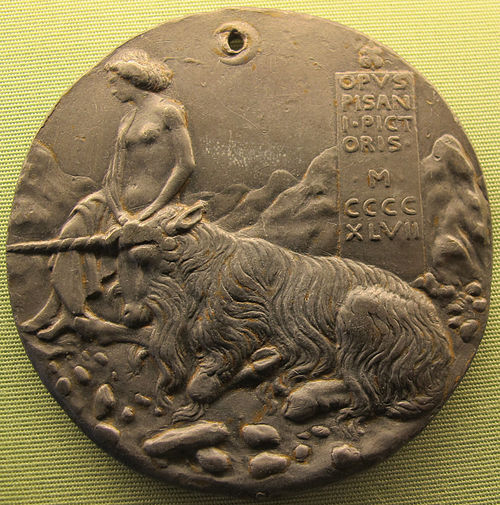
Reverse of the same medal, this copy with a suspension hole added later (inside a crescent moon in the design).
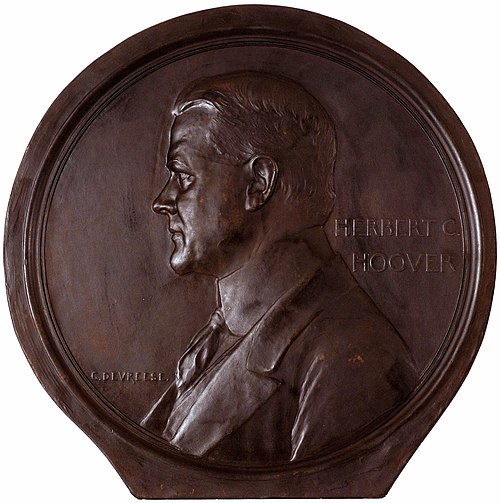
Medal depicting Herbert C. Hoover by Devreese Godefroi

Various prize medals with obverse designs, suspension rings and ribbons typical of medals intended to be draped over the head and hung from the neck