Giants (Greek mythology)
Videos
In Greek and Roman mythology, the Giants, also called Gigantes, were a race of great strength and aggression, though not necessarily of great size, known for the Gigantomachy, their battle with the Ol
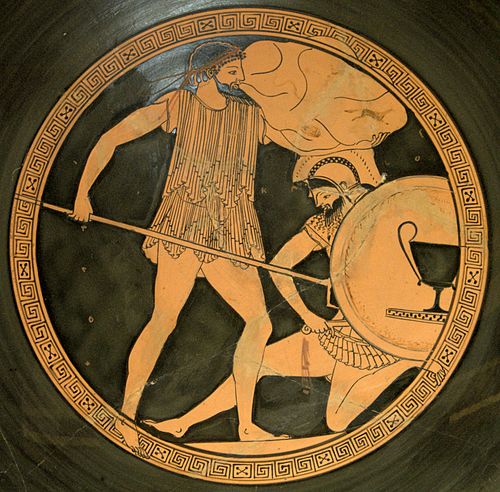
Poseidon (left) holding a trident, with the island Nisyros on his shoulder, battling a Giant (probably Polybotes), red-figure cup c. 500–450 BC (Cabinet des Médailles 573)

Athena (left) fighting the Giant Enceladus (inscribed retrograde) on an Attic red-figure dish, c. 550–500 BC (Louvre CA3662).

Dionysus (left) with ivy crown, and thyrsus attacking a Giant, Attic red-figure pelike, c. 475–425 BC (Louvre G434).

Ancient Roman mosaic with Poseidon fighting Polybotes, exhibited in Rhodes.
Titans
Videos
In Greek mythology, the Titans were the deities who preceded the Olympians. According to the Theogony of Hesiod, they were the twelve children of the primordial deities Uranus and Gaia. The six male T
Giants (Greek mythology)
…Olympian gods. According to Hesiod, the Giants were the offspring of Gaia (Earth), born from the blood that fell when Uranus (Sky) was castrated by his Titan son Cronus. Archaic and Classical representations show Gigantes as man-sized hoplites (heavily armed ancient Greek foot soldiers) fully human in form…
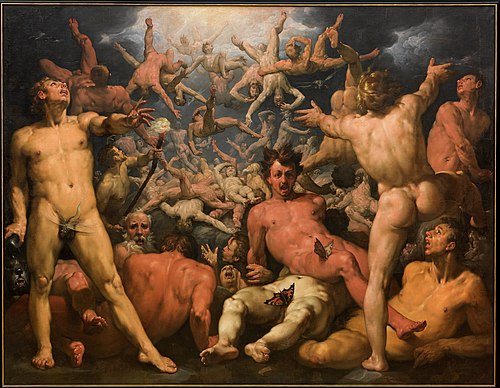
The Fall of the Titans (1596–98), a mythological painting by Dutch painter Cornelis van Haarlem.
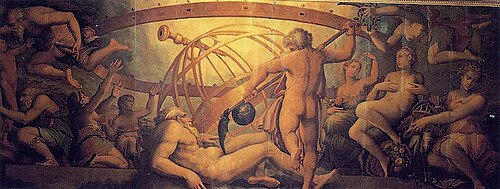
The Mutilation of Uranus by Saturn: fresco by Giorgio Vasari and Cristofano Gherardi, c. 1560 (Sala di Cosimo I, Palazzo Vecchio)

Rhea presenting Cronus the stone wrapped in cloth

"Fall of the Titans". Oil on canvas by Jacob Jordaens, 1638.