Glacier
Videos
A glacier is a persistent body of natural ice, a form of rock, that is constantly moving under its own weight. A glacier forms where the accumulation of snow exceeds its ablation over many years, ofte

Glacier of the Geikie Plateau in Greenland

The Taschachferner in the Ötztal Alps in Austria. The mountain to the left is the Wildspitze (3,768 m), the second highest in Austria

The Baltoro Glacier in Pakistan. It is 62 kilometres (39 mi) long, the fifth longest alpine glacier in the world.
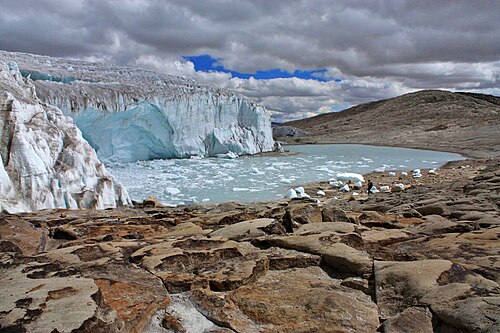
The Quelccaya Ice Cap in Peru is the second-largest glaciated area in the tropics
Serac
Videos
A serac is a block or column of glacial ice, often formed by intersecting crevasses on a glacier. Commonly house-sized or larger, they are dangerous to mountaineers and alpinists, since they may toppl
Glacier
…under stresses induced by gravity, undergoing both ductile and brittle deformation, and acquiring distinguishing surface features, such as crevasses and seracs. As a glacier moves, it abrades underlying rock and debris to create glacial landforms, such as cirques, moraines, and fjords. Although a glacier may…

Fox Glacier, New Zealand

Serac, Russell Glacier in Greenland

Seracs in firn at 3,050 metres (10,000 feet) on the Winthrop Glacier of Mount Rainier in Washington, USA

Seracs, Bossons Glacier, southeastern France