Gliding is a recreational activity and competitive air sport in which pilots fly unpowered aircraft known as gliders or sailplanes using naturally occurring currents of rising air in the atmosphere to remain airborne. The word soaring is also used for the sport.
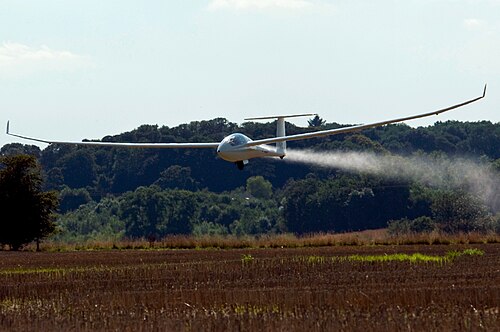
A Ventus-2 glider landing while jettisoning water that has been carried as ballast
The "gull wing" Göppingen Gö 3 Minimoa produced in Germany from 1936
Good gliding weather: Competitors studying cumulus humilis, which suggest active thermals and light winds.
A lenticular cloud produced by a mountain wave
In meteorology, lee waves are atmospheric stationary waves. The most common form is mountain waves, which are atmospheric internal gravity waves. These were discovered in 1933 by two German glider pilots, Hans Deutschmann and Wolf Hirth, above the Giant Mountains.
They are periodic changes of atmospheric pressure, temperature and orthometric height in a current of air caused by vertical displacement, for example orographic lift when the wind blows over a mountain or mountain range. They can also be caused by the surface wind blowing over an escarpment or plateau, or even by upper winds deflected over a thermal updraft or cloud street.
Lenticular clouds
A fluid dynamics lab experiment illustrates flow past a mountain-shaped obstacle. Downstream wave crests radiate upwards with their group velocity pointing about 45° from horizontal. A downslope jet can be seen in the lee of the mountain, an area of lower pressure, enhanced turbulence, and periodic vertical displacement of fluid parcels. Vertical dye lines indicate effects are also felt upstream of the mountain, an area of higher pressure.
A wave window over the Bald Eagle Valley of central Pennsylvania as seen from a glider looking north. The wind flow is from upper left to lower right. The Allegheny Front is under the left edge of the window, the rising air is at the right edge, and the distance between them is 3–4 km.
Hydrostatic wave (schematic drawing)