Global spread of the printing press
The global spread of the printing press began with the invention of the printing press with movable type by Johannes Gutenberg in Mainz, Germany c. 1439. Western printing technology was adopted in all world regions by the end of the 19th century, displacing the manuscript and block printing.
Modern stamp commemorating the Gutenberg Bible, the first major European work printed by mechanical movable type
A printing press is a mechanical device for applying pressure to an inked surface resting upon a print medium, thereby transferring the ink. It marked a dramatic improvement on earlier printing methods in which the cloth, paper, or other medium was brushed or rubbed repeatedly to achieve the transfer of ink and accelerated the process. Typically used for texts, the invention and global spread of the printing press was one of the most influential events in the second millennium.
Recreated Gutenberg press at the International Printing Museum, Carson, California
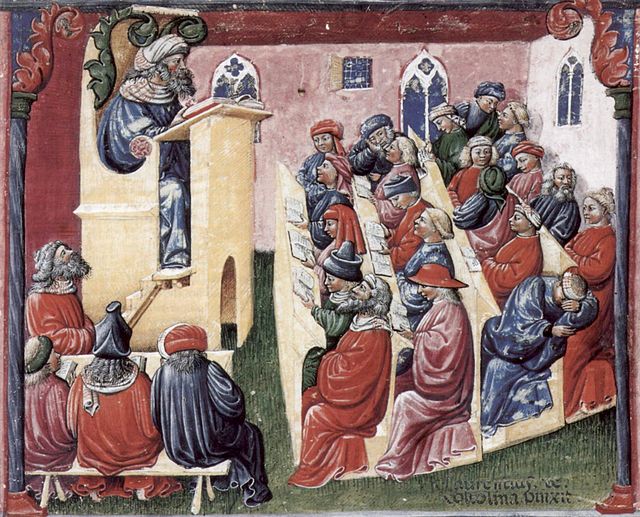
Medieval university class (1350s)
Early modern wine press. Such screw presses, used in Europe for a wide range of uses, provided Gutenberg with the model for his printing press.
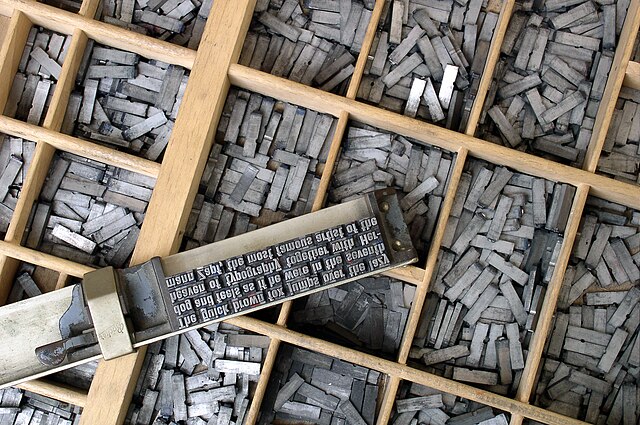
Movable type sorted in a letter case and loaded in a composing stick on top