Go (game)
Videos
Go is an abstract strategy board game for two players in which the aim is to capture more territory than the opponent by fencing off empty space. The game was invented in China more than 2,500 years ago and is believed to be the oldest board game continuously played to the present day. A 2016 survey by the International Go Federation's 75 member nations found that there are over 46 million people worldwide who know how to play Go, and over 20 million current players, the majority of whom live in East Asia.

Go is played on a grid (usually 19×19). Game pieces (stones) are played on the grid line intersections.

Model of a 19×19 Go board, from a tomb of the Sui dynasty (581–618 CE)
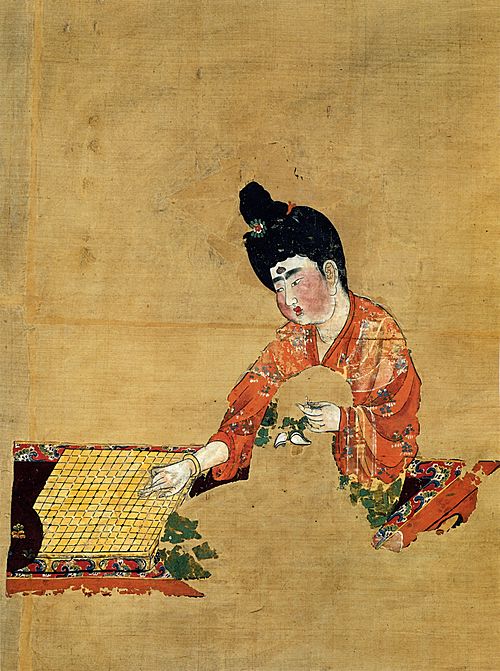
Painting of a woman playing Go, from the Astana Graves. Tang dynasty, c. 744 CE.

Li Jing playing Go with his brothers. Detail from a painting by Zhou Wenju (fl. 942–961 CE), Southern Tang dynasty.
Board game
Videos
Board games are tabletop games that typically use pieces. These pieces are moved or placed on a pre-marked board and often include elements of table, card, role-playing, and miniatures games as well.

The board game Monopoly is licensed in 103 countries and printed in 37 languages.

Young girls playing a board game in the Iisalmi library in Finland, 2016

Senet, one of the oldest known board games

Hounds and jackals (Egypt, 13th Dynasty)