Gold lunula
Videos
A gold lunula was a distinctive type of late Neolithic, Chalcolithic, and—most often—early Bronze Age necklace, collar, or pectoral shaped like a crescent moon. Most are from Prehistoric Ireland. They

Gold lunula from Blessington, Ireland, Late Neolithic/Early Bronze Age, c. 2400BC – 2000BC, Classical group

Provincial "dot-line" lunula from Kerivoa in Brittany, France

Lunula found in Scotland, 2300-2000 BC
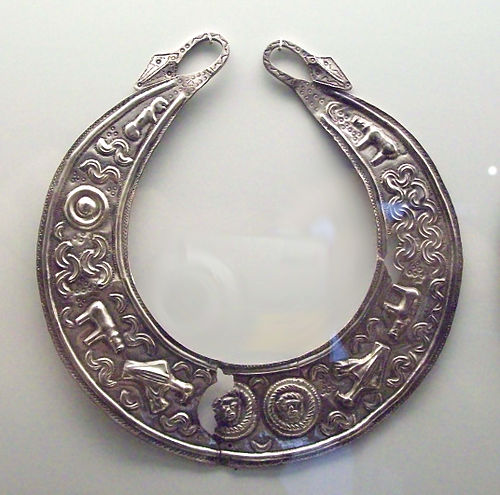
Lusitanian silver lunula, Miranda do Corvo (Portugal)
Bell Beaker culture
Videos
The Bell Beaker culture, also known as the Bell Beaker complex or Bell Beaker phenomenon, is an archaeological culture named after the inverted-bell beaker drinking vessel used at the beginning of the
Gold lunula
…suggesting ritual deposits, more were found on higher ground, often under standing stones. Most gold lunulae have decorative patterns very much resembling beaker pottery from roughly the same period, using geometrical patterns made up of straight lines, with zig-zags and criss-cross patterns, and many different axes of…

Distribution of the area of influence of the Bell Beaker culture

Bell Beaker artefacts from Spain: ceramics, metal daggers, axe and javelin points, stone wristguards and arrowheads

Reconstruction of a Bell Beaker burial, Spain.

Corded Ware, Yamnaya and Sintashta cultures