Good Shepherd
Videos
The Good Shepherd is an image used in the pericope of John 10:1–21, in which Jesus Christ is depicted as the Good Shepherd who lays down his life for his sheep. Similar imagery is used in Psalm 23 and
The Good Shepherd, made c. 300–350 and discovered in the 18th century at the Catacomb of Callixtus, Rome.


Allegory of Christ as the Good Shepherd, 3rd century. The pail (of milk?) carried by the Shepherd has been seen as symbolizing the Eucharist by some.

Late Roman marble copy of the Kriophoros of Calamis (Museo Barracco, Rome)

At the Catacomb of Priscilla, 3rd century A.D., Rome
Depiction of Jesus
Videos
The depiction of Jesus in pictorial form dates back to early Christian art and architecture, as aniconism in Christianity was rejected within the ante-Nicene period. It took several centuries to reach
Good Shepherd
…but three allegories, the Synoptists present it as parabolic through and through." The image of the Good Shepherd is the most common of the symbolic representations of Christ found in early Christian art in the Catacombs of Rome, before Christian imagery could be made explicit. The form of the image showing a young man…
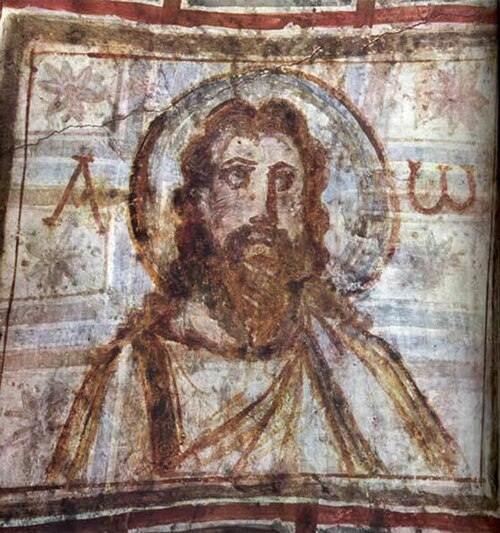
A mural painting from the catacomb of Commodilla. One of the first bearded images of Jesus, late 4th century.

Incised sarcophagus slab with the Adoration of the Magi from the Catacombs of Rome, 3rd century. Plaster cast with added colour.

Dura Europos fresco which was dubbed The Healing of the Paralytic – one of the oldest possible depictions of Jesus, although there are different interpretations of the scene. from the Syrian city of Dura Europos, dating from about 235 AD

Bearded Jesus between Peter and Paul, Catacombs of Marcellinus and Peter, Rome. Second half of the 4th century. Such works "first present us with the fully formed image of Christ in Majesty that will so dominate Byzantine art." For detail of Christ, see this file.